There are days when I cannot make another food decision. I have spent eight hours at work negotiating, problem-solving, and managing details. My brain is empty. The idea of measuring portions, counting macros, or choosing between recipes feels like an impossible task. I used to solve these issues by ordering takeout or eating cereal for dinner. Neither choice made me feel good.
What I needed was a system that required zero thought but still produced a nourishing meal. Not a recipe. Not a diet plan. A visual template that my eyes could understand even when my brain was done for the day. I found it in the simple plate method and have used it for dinner at least 3 times a week for the past year.
This is not a weight loss strategy. It is a decision-elimination strategy. When thinking is not an option, the plate method still produces a balanced meal. Here is exactly how it works, why it sustains me, and how to adapt it for your needs.
Why Complicated Systems Fail on Hard Days
Most healthy eating advice assumes you have mental energy to spare. Measure your protein. Weigh your carbohydrates. Track your vegetables. Plan your meals. These are excellent strategies when you are rested and motivated. They are terrible strategies when you are exhausted and hungry.
Decision fatigue is a real phenomenon. Research from the National Academy of Sciences demonstrates that the quality of decisions deteriorates after a long session of decision-making. Judges making parole decisions were more likely to grant parole after a meal break and less likely as the session progressed. Your brain has a finite capacity for choices, and by 7 p.m., most people have depleted it.
I tried meal prepping on Sundays to solve this problem. It worked for a few weeks, then life intervened. I missed a Sunday, then another. The prepared meals ran out, and I was back to staring into the refrigerator with no plan. I needed something simpler than meal prep. Something that worked even when I had done nothing in advance.
The Exhaustion Threshold
Your healthy eating system must work at your worst, not just at your best. If a strategy requires motivation, planning, or cognitive effort, it will fail precisely when you need it most. The plate method works because it requires no preparation, no measuring, and no decisions beyond filling sections of a plate. When your brain is empty, your eyes can still manage that.
The Exact Plate Method I Use
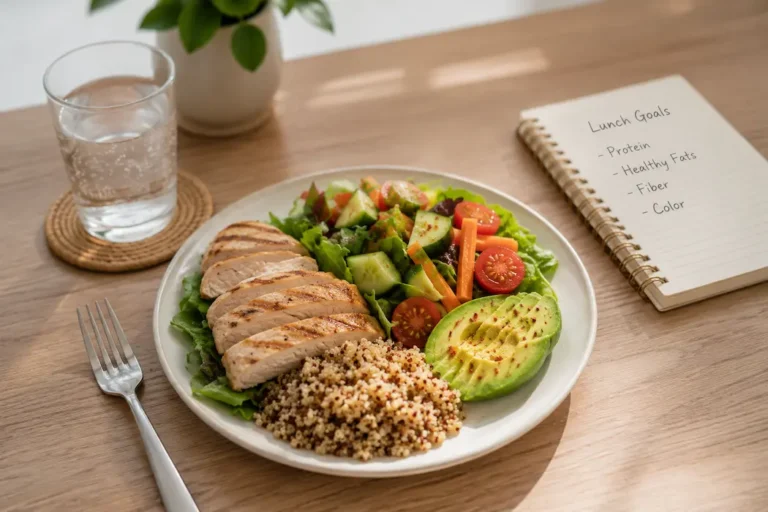
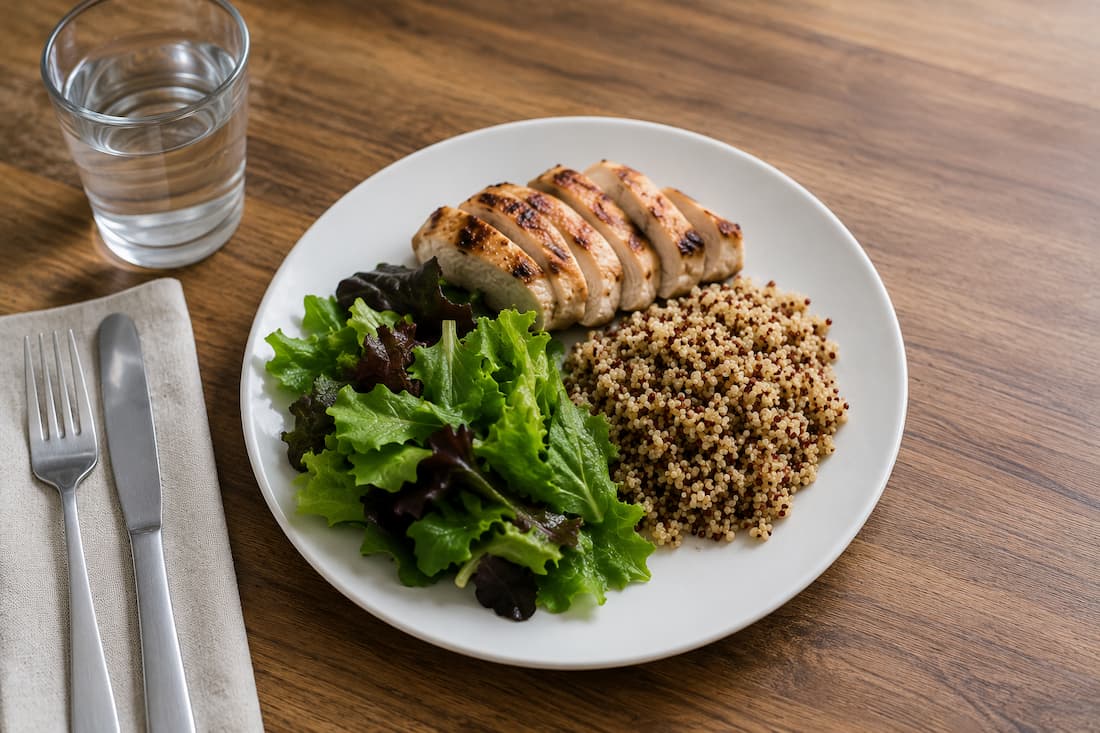
I use a standard dinner plate, approximately 10 inches in diameter. I divide it visually into three sections. No measuring tools. No scales. Just the plate itself as a guide.
| Section | Plate Coverage | What Goes There |
|---|---|---|
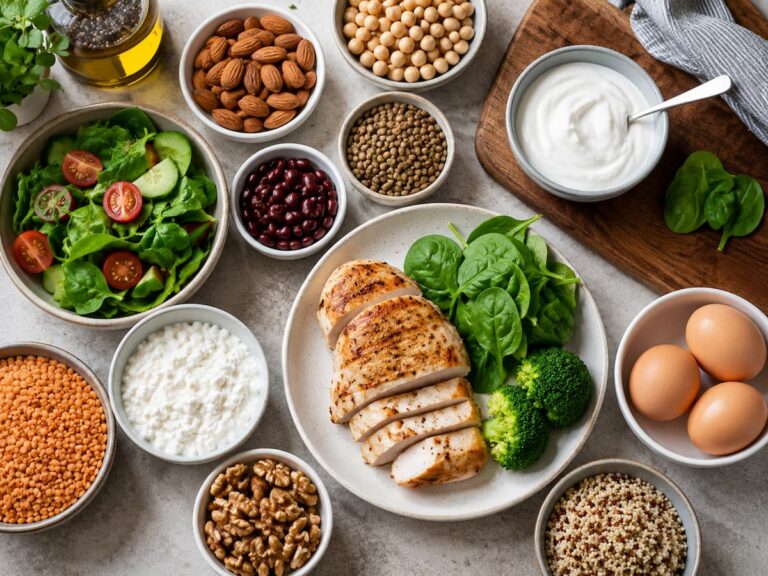
| Half the plate | 50% | Non-starchy vegetables. Anything that grows above ground and is not a grain or legume. Broccoli, spinach, peppers, tomatoes, cucumbers, zucchini, salad greens, cauliflower, asparagus, green beans. |
| Quarter of the plate | 25% | Protein. Chicken, fish, beef, pork, tofu, tempeh, eggs, legumes, or a combination. A portion roughly the size of my palm. |
| Quarter of the plate | 25% | Complex carbohydrates or starchy vegetables. Brown rice, quinoa, sweet potato, whole grain pasta, lentils, beans, or whole grain bread. |
The remaining element is fat, which I add without measuring. A drizzle of olive oil on the vegetables. A handful of nuts or seeds. A quarter of an avocado. The fat is not a section of the plate because it is often incorporated into the other sections or added as a condiment. It is present, but not visually dominant.
This method takes less than five minutes to assemble if I have basic ingredients available. The vegetables are often raw or quickly steamed. The protein is frequently leftover from a previous meal, quickly pan-seared, or canned fish. The carbohydrate is usually reheated grains or a piece of bread. No recipe required. No cooking expertise needed.
What a Typical Plate Looks Like
Here are three actual dinners I have eaten using this method in the past month. Each took under ten minutes to prepare.
| Meal | Vegetables (Half Plate) | Protein (Quarter Plate) | Carbohydrate (Quarter Plate) |
|---|---|---|---|
| Monday | Steamed broccoli and roasted red peppers with olive oil | Grilled chicken thigh, reheated | Half a baked sweet potato |
| Wednesday | Large mixed salad with cucumber, tomato, spinach, lemon juice | Canned sardines, drained | Two slices of whole grain bread |
| Friday | Sauteed zucchini and mushrooms with garlic | Pan-fried tofu cubes | Quinoa, reheated from Sunday batch |
None of these meals required a recipe. The Monday chicken was leftover from Sunday. The Wednesday sardines came from a can opened at the counter. The Friday tofu was pressed while the vegetables cooked, then thrown in the same pan for three minutes. The plate method does not demand culinary skill. It demands only that you fill the sections.
The No-Recipe Advantage
Recipes are wonderful when you have time and energy. They are obstacles when you do not. The plate method replaces recipes with a template. You do not need to know how to cook. You need to know how to fill half a plate with vegetables. Any cooking method works: raw, steamed, roasted, sauteed, or leftover. The method is agnostic to technique. This is why it survives busy weeks, travel, and exhaustion.
How I Stock for This Method
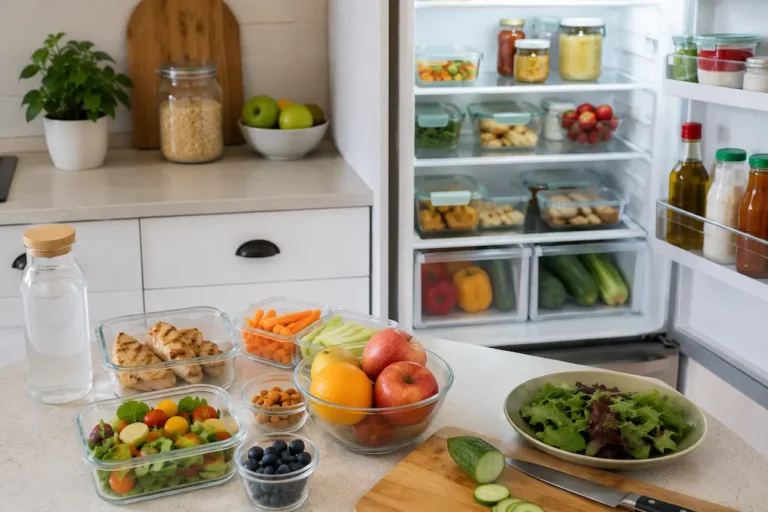
The plate method only works if you have ingredients that fit the sections. I keep a rotating stock of items that can fill each category with minimal preparation. This is not meal prepping. It is ingredient prepping. I prepare components, not meals.
Vegetables: I always have at least three types of vegetables that require zero cooking. Cherry tomatoes, cucumbers, bell peppers, and bagged salad greens are staples. I also keep frozen broccoli, spinach, and mixed vegetables for days when fresh options are gone. Frozen vegetables are nutritionally comparable to fresh and require only microwaving or brief steaming.
Proteins: I keep cooked chicken or hard-boiled eggs in the refrigerator most days. Canned fish — tuna, sardines, salmon — provides emergency protein that requires no preparation. For plant-based days, I keep marinated tofu or canned beans. Each of these options can be on the plate within two minutes.
Carbohydrates: I batch-cook grains on Sunday. A pot of brown rice or quinoa lasts the week. I also keep whole grain bread and sweet potatoes, which can be quickly microwaved if not already cooked. These are not exciting, but they are reliable.
Fats: Olive oil, nuts, seeds, and avocado are always available. I do not measure these. A drizzle, a handful, or a quarter of an avocado is sufficient. The fat enhances flavor and satiety without requiring precision.
What Happens When I Am Missing a Section
Real life does not always provide all three sections. Some nights my refrigerator is nearly empty. Some nights I am at a restaurant or someone else’s home. The plate method adapts rather than breaks.
Missing vegetables: If I have no fresh or frozen vegetables, I double the carbohydrate section and add a piece of fruit afterward. This is not ideal, but it is better than abandoning the method entirely. The next day, I prioritize vegetable shopping.
Missing protein: If protein is unavailable, I increase the carbohydrate to half the plate and add beans or lentils if possible. If even that is unavailable, I eat a larger portion of grains and add nuts or seeds for protein and fat. Again, imperfect but functional.
Missing carbohydrates: This is the easiest gap to fill. I simply increase the vegetable and protein portions. Many of my dinners are effectively half vegetables, half protein, with fat added for satiety. This happens frequently and works well.
At restaurants: I visually estimate the plate sections. I order a side of vegetables if the main dish is protein-heavy. I ask for extra vegetables instead of the standard starch if I am not in the mood for carbohydrates. Most restaurants can accommodate these requests without difficulty.
What Changed After Using This Method for Six Months
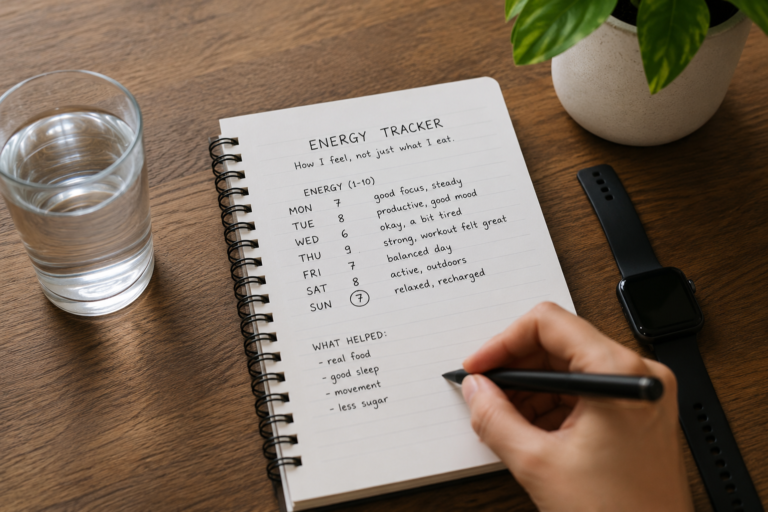
I tracked two metrics during my first six months: how often I used the plate method versus other eating approaches, and how I felt after meals. The results were revealing.
| Metric | Before Plate Method | After 6 Months |
|---|---|---|
| Dinner preparation time | 30-45 minutes or takeout | 10-15 minutes |
| Evening energy after dinner | Often sluggish, sometimes bloated | Generally comfortable, rarely sluggish |
| Vegetable intake at dinner | Small side portion or absent | Half the plate consistently |
| Decision stress about dinner | High; often avoided until too hungry | Minimal; method is automatic |
| Takeout frequency | 3-4 times per week | 1-2 times per week |
The reduction in decision stress was the most significant change. I stopped dreading dinner because I stopped negotiating with myself about what to eat. The plate was the decision. I just filled it. This freed mental energy for other things and prevented the spiral of indecision that used to end in poor choices.
Why This Is Not a Diet
I want to be clear about what this method is not. It is not a weight loss plan. It does not restrict calories, eliminate food groups, or promise specific outcomes. It is a structure for eating when structure is needed and thought is unavailable.
The plate method can accommodate any dietary approach. Vegetarians fill the protein section with legumes, tofu, or eggs. Paleo eaters omit grains and fill the carbohydrate section with starchy vegetables. Those managing diabetes can emphasize non-starchy vegetables and choose lower-glycemic carbohydrates. The method is a container, not a content mandate.
Research from the Harvard T.H. Chan School of Public Health supports this approach. Their Healthy Eating Plate model, developed independently of my personal method, similarly emphasizes half the plate for vegetables and fruits, one-quarter for whole grains, and one-quarter for healthy protein. The consistency across different sources suggests that the visual plate approach aligns with nutritional principles without requiring expertise to implement.
The Flexibility Principle
The best eating system is the one you actually use. Complicated plans fail because they require resources you do not always have. The plate method succeeds because it is simple enough to execute when you are exhausted, busy, or unmotivated. It does not produce perfect meals. It produces adequate meals consistently, which is far more valuable than perfect meals occasionally.
How to Start Using the Plate Method
If you currently struggle with dinner decisions, start tomorrow. Look at your plate. Fill half with whatever vegetables you have. Fill one quarter with whatever protein is available. Fill the remaining quarter with a carbohydrate. Add some fat. Eat.
Do not worry about the specific foods at first. Worry about the proportions. Over time, you will naturally improve the quality of what fills each section as you notice how different foods make you feel. The method creates a framework for observation. Your body provides the feedback that shapes future choices.
Keep basic ingredients stocked for each section. This is not meal prepping. It is having options available. When you open your refrigerator and see vegetables, protein, and grains, the plate method becomes automatic. When you see nothing, it becomes impossible.
I have used this method through busy work weeks, illness, travel, and periods of low motivation. It has never failed me because it asks so little. Half vegetables. Quarter protein. Quarter carbohydrates. A little fat. That is the entire system. On the days when thinking is not an option, it is exactly enough.
Related Articles
- How to Prepare Quick Nutrient-Dense Meals on Busy Days
- What I Keep in My Kitchen to Make Healthy Eating Automatic
- How I Stopped Overeating at Dinner by Eating a Bigger Lunch
- How I Eat Better Without Strict Dieting
- How I Cut Sugar Cravings Using a 3-Week Protein-First Experiment
- How I Fixed Afternoon Slumps Using a Simple Hydration Schedule
Sources and References
- Danziger, S., Levav, J., & Avnaim-Pesso, L. (2011). “Extraneous factors in judicial decisions.” Proceedings of the National Academy of Sciences, 108(17), 6889-6892. https://www.pnas.org/doi/10.1073/pnas.1018033108
- Harvard T.H. Chan School of Public Health. “The Healthy Eating Plate.” https://www.hsph.harvard.edu/nutritionsource/healthy-eating-plate/
- USDA. “MyPlate Plan.” https://www.myplate.gov/

Abdur Rahman is a lifestyle writer focused on simple health habits and everyday wellness. He creates easy-to-understand content that helps readers improve their routines without confusion or pressure. His work covers topics like daily health habits, home fitness, simple nutrition, sleep, and stress management. He believes that small, consistent actions lead to meaningful long-term results and aims to make healthy living practical, realistic, and accessible for everyone.