
I spent three years tracking every calorie that entered my body. I used apps, spreadsheets, and a kitchen scale that I carried in my bag when eating out. I knew the caloric content of a banana, a tablespoon of olive oil, and a slice of pizza from three different restaurants. I was precise, disciplined, and utterly miserable.
The problem was not that calorie counting failed to produce weight changes. It worked, sporadically. The problem was that it disconnected me from my own body. I would eat a 400-calorie meal that left me exhausted and hungry an hour later, or a 600-calorie meal that satisfied me for four hours. The numbers told me nothing about how food actually made me feel. I was optimizing for a spreadsheet, not for a human being.
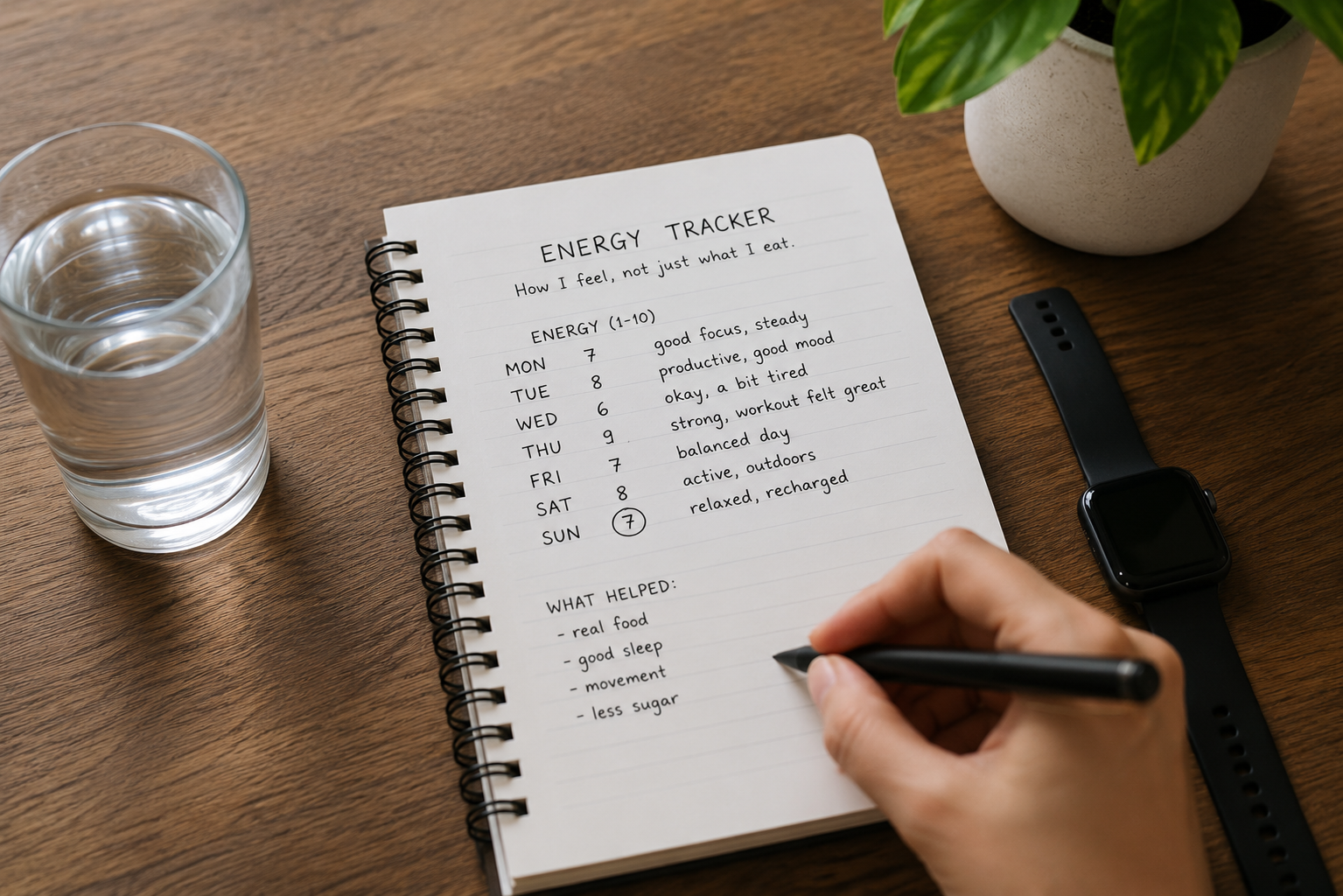
The shift happened gradually. I started noticing patterns the calorie app could not capture. Some days I ate more and felt better. Some days I hit my target perfectly and felt terrible. The disconnect between the numbers and my experience became too large to ignore. I stopped counting calories entirely and began tracking something else: my energy.
What Calorie Counting Actually Taught Me
Before dismissing calorie counting entirely, I want to acknowledge what it did provide. It taught me portion awareness. I learned what a serving of rice actually looks like, how much oil I was using, and how quickly restaurant portions exceed reasonable amounts. This baseline knowledge was valuable and remains with me.
Calorie counting also created a period of structured eating that broke some of my worst habits. I stopped mindlessly snacking because I had to log it. I stopped drinking sugary beverages because the numbers were shocking. These were genuine benefits that I do not regret.
But the costs accumulated. I became anxious about social meals because I could not measure accurately. I chose foods based on their caloric density rather than their nutritional value. I ignored hunger signals because I had already “used” my calories for the day. I ate foods that left me depleted because they fit my numbers. The system was technically correct and practically destructive.
The Precision Trap
Calorie counting promises precision, but human metabolism is not precise. The calories listed on food labels can vary by 20 percent from actual content. Your body absorbs different amounts of calories from the same food depending on preparation, your gut microbiome, and your current metabolic state. Chasing perfect accuracy in an inherently imprecise system creates anxiety without improving outcomes. The numbers feel scientific, but they are estimates dressed in certainty.
What I Started Tracking Instead
Energy tracking is simpler and more subjective than calorie counting, which is exactly why it works. I use a 1-10 scale to rate my energy at four points during the day: upon waking, mid-morning, mid-afternoon, and early evening. I also note my hunger, mood, and mental clarity using the same scale. Then I look for patterns connecting what I ate to how I felt.
This is not a rigid system. There are no targets to hit, no penalties for missing a number. The goal is observation, not optimization. I want to understand my body’s responses, not control them.
<
| Metric | How I Track It | What It Reveals |
|---|---|---|
| Energy | 1-10 scale at 7 a.m., 11 a.m., 3 p.m., 6 p.m. | Which meals sustain me and which deplete me |
| Hunger | 1-10 scale before and 2 hours after each meal | Which foods actually satisfy versus which leave me wanting more |
| Mood | 1-10 scale at 3 p.m. and 8 p.m. | How food affects irritability, anxiety, and emotional stability |
| Mental clarity | 1-10 scale during focused work sessions | Which foods support concentration and which create brain fog |
| Digestive comfort | Simple note: comfortable, bloated, sluggish, or sharp | Which foods my body processes easily and which cause distress |
The tracking takes two minutes per day. I use a simple notes app on my phone. No graphs, no trends, no analysis unless I choose to look back. The simplicity is the point. If tracking becomes burdensome, it stops being useful.
What I Learned in the First Month
The patterns emerged faster than I expected. Within two weeks, I noticed that my energy consistently crashed after meals heavy in refined carbohydrates, regardless of the total calories. A 500-calorie sandwich on white bread produced a 3 p.m. energy collapse. A 600-calorie meal of salmon, vegetables, and quinoa sustained me until evening.
I also discovered that my hunger was not reliably connected to calories. Some 300-calorie snacks left me hungrier than before I ate them. Others satisfied me for hours. The difference was protein and fiber content, not caloric density. A small handful of almonds and an apple was more satiating than a larger serving of crackers, despite fewer calories.
My mood was the most surprising revelation. I had assumed my afternoon irritability was work-related stress. The tracking revealed it was consistently worse on days when I ate a carbohydrate-heavy lunch and skipped protein. The connection was so reliable that I could predict my 3 p.m. mood based on my lunch composition.
The Mood-Food Connection
I had spent years attributing my emotional fluctuations to work stress, sleep quality, or vague personality traits. The energy tracking revealed that a significant portion of my mood variability was directly connected to food choices I made six hours earlier. This was not about being “emotional about food.” It was about blood sugar stability affecting neurotransmitter production. The realization was humbling and liberating. I could not control my job, but I could control my lunch.
How This Changed What I Eat
The shift from calorie counting to energy tracking fundamentally changed my food choices, but not in the ways I expected. I did not start eating “healthier” in the conventional sense. I started eating in ways that made me feel better, which turned out to be healthier as a side effect.
I stopped fearing fat. Calorie counting had made me avoid nuts, avocados, and olive oil because they were calorically dense. Energy tracking showed that these foods sustained my energy and satiety for hours. I now include them generously, and my total daily intake has naturally regulated itself because I am less hungry overall.
I started prioritizing protein at breakfast. Calorie counting had led me to choose low-calorie options like toast with jam or a small bowl of cereal. Energy tracking revealed that these breakfasts left me hungry and irritable by mid-morning. Two eggs with vegetables, despite being higher in calories, produced stable energy and better mood until lunch.
I reduced my reliance on processed “diet” foods. Calorie counting had made these attractive because they offered volume for few calories. Energy tracking revealed that they rarely satisfied me and often left me craving more. Real food, even in smaller portions, consistently outperformed processed alternatives on every metric I tracked.
<
| Food Category | Calorie Counting Perspective | Energy Tracking Perspective |
|---|---|---|
| Nuts and seeds | High calorie, eat sparingly | High satiety, sustained energy, eat generously |
| Eggs | Moderate calorie, acceptable | Excellent energy stability, essential for breakfast |
| White bread and pasta | Moderate calorie, portion carefully | Energy crash, mood decline, minimize |
| Diet processed foods | Low calorie, ideal for weight loss | Low satisfaction, increased cravings, avoid |
| Vegetables with olive oil | Oil adds calories, use sparingly | Fat enhances nutrient absorption, improves satiety |
| Fruit | Natural sugar, count as carbs | Quick energy, pairs well with protein, excellent snack |
The Psychological Difference
The most profound change was not in my body but in my mind. Calorie counting created a constant low-grade anxiety. Every meal was a math problem. Every social event was a planning challenge. Every hunger pang was a potential failure. The system made food an adversary to be managed rather than nourishment to be enjoyed.
Energy tracking reversed this relationship. Food became information. A meal that left me energized was a success, regardless of its caloric content. A meal that depleted me was data, not a failure. The emotional charge around eating diminished dramatically.
I also stopped the cycle of restriction and compensation that calorie counting encouraged. Missing my target by 200 calories would trigger either punitive undereating the next day or abandon-ship overeating because I had “already failed.” Energy tracking has no targets to miss. There is no failure mode. There is only observation and gradual adjustment.
This psychological shift is supported by research. Studies on intuitive eating, which emphasizes body awareness over external rules, consistently show improved psychological well-being, reduced disordered eating patterns, and sustained healthy behaviors compared to rigid dietary control. The Journal of Counseling Psychology published a meta-analysis finding that intuitive eating was associated with lower body mass index, better body image, and greater life satisfaction than calorie-restricted approaches.
The Permission Effect
Calorie counting operates through restriction. Energy tracking operates through permission. When you track how food makes you feel, you are implicitly telling yourself that your experience matters. Your body’s signals are valid data. This creates a collaborative relationship with yourself rather than an adversarial one. The difference in daily quality of life is difficult to overstate. I no longer dread meals. I look forward to them as experiments in personal optimization.
What I Still Do From My Calorie Counting Days
I have not abandoned everything I learned. The portion awareness remains valuable. I still roughly know the caloric content of common foods, which helps me make reasonable choices without obsessive tracking. I maintain the habit of eating vegetables at every meal, which I developed during my calorie counting phase because they provided volume for few calories.
I also retained the practice of planning meals in advance, though the criteria have changed. Instead of planning around caloric targets, I plan around energy needs. A day with heavy physical activity gets more carbohydrates. A day with intense mental work gets more protein and healthy fats. The planning is more responsive and less rigid.
The kitchen scale still exists but gathers dust. I use it occasionally for baking, where precision matters, but never for daily meals. My hand serves as a portion guide: a palm of protein, a fist of vegetables, a cupped hand of carbohydrates, a thumb of fat. These rough measures are sufficient for energy tracking and far more sustainable than gram-level precision.
How to Start Energy Tracking
If you are currently calorie counting and feeling the strain I described, the transition is simple. For one week, continue your calorie tracking but add energy ratings. Do not change anything yet. Just observe. Rate your energy, hunger, mood, and mental clarity at the times I described.
At the end of the week, look for patterns. Which meals produced the highest energy scores? Which produced the lowest? Did the calorie content predict the energy outcome? In my experience, the correlation was weaker than I had assumed.
Then, for a second week, make one change based on your observations. Maybe you add protein to breakfast because your mid-morning energy was consistently low. Maybe you reduce refined carbohydrates at lunch because your afternoon crash was predictable. Track the results. Adjust again.
By week three, you may find that calorie counting has become redundant. Your body is telling you what works. The numbers are just a translation layer that you no longer need. I abandoned calorie tracking entirely after two weeks of energy tracking because the data from my own body was more actionable than any external metric.
When Energy Tracking Is Not Enough
This approach assumes you can generally trust your body’s signals. For some people, this is not true. Certain medical conditions, medications, and psychological states disrupt the normal hunger-satiety-energy system. If you have diabetes, thyroid disorders, eating disorder history, or are on medications that affect appetite, consult a healthcare provider before making significant changes.
Energy tracking also requires honest self-assessment. If you are prone to rationalizing poor choices or dismissing negative outcomes, the system will not work. The value depends entirely on your willingness to observe without judgment and adjust without shame.
Finally, energy tracking is not a weight loss method. It is a body awareness method. Weight may change as a side effect of better food choices, but it is not the target. If your primary goal is rapid weight loss, this approach will feel frustratingly indirect. It is designed for sustainable health, not rapid transformation.
I stopped counting calories because the numbers were making me miserable without making me healthier. I started tracking energy because my body was already speaking. I just needed to learn its language. The conversation has been far more productive than any spreadsheet ever was.
Related Articles
- How I Eat Better Without Strict Dieting
- How I Stopped Overeating at Dinner by Eating a Bigger Lunch
- What I Keep in My Kitchen to Make Healthy Eating Automatic
- How I Cut Sugar Cravings Using a 3-Week Protein-First Experiment
- How to Prepare Quick Nutrient-Dense Meals on Busy Days
- How I Fixed Afternoon Slumps Using a Simple Hydration Schedule
Sources and References
- Van Dyke, N., & Drinkwater, E.J. (2014). “Relationships between intuitive eating, health indicators and disordered eating.” Journal of Counseling Psychology, 61(3), 360-375. https://psycnet.apa.org/record/2014-14432-001
- Bacon, L., & Aphramor, L. (2011). “Weight science: evaluating the evidence for a paradigm shift.” Nutrition Journal, 10, 9.
- Tribole, E., & Resch, E. (2012). Intuitive Eating. 3rd Edition. St. Martin’s Press.

Abdur Rahman is a lifestyle writer focused on simple health habits and everyday wellness. He creates easy-to-understand content that helps readers improve their routines without confusion or pressure. His work covers topics like daily health habits, home fitness, simple nutrition, sleep, and stress management. He believes that small, consistent actions lead to meaningful long-term results and aims to make healthy living practical, realistic, and accessible for everyone.