The burnout didn’t announce itself with drama. It crept in through the back door, disguised as normal fatigue. I told myself I was just tired, that everyone feels this way, that a good night’s sleep would fix it. But the sleep didn’t fix it. Neither did the weekend. By Monday morning, I sat at my desk staring at a screen I couldn’t process, my mind a static hum of exhaustion and vague dread.
I had been running on momentum for months. Early mornings, late evenings, constant availability, perpetual motion. The work got done. The deadlines were met. But I was paying for efficiency with something I didn’t realize was depleting: my capacity to recover. Burnout isn’t a single bad week. It’s the accumulation of weeks where recovery never fully happened, where stress accumulated faster than it dissipated, where the gap between what I needed and what I gave myself grew wider until it became a chasm.
That Monday, I made a decision. Not to push through, not to take a vague “break,” but to design a specific three-day reset that would address the physiological, psychological, and environmental dimensions of my burnout. I had no template. I had only the conviction that recovery required intention, not just time. The plan I created worked better than I expected. Here’s exactly what I did and why each element mattered.
Recognizing That I Was Burned Out, Not Just Tired
This distinction saved me from making the wrong response. Tiredness responds to rest. Burnout responds to systemic change. If I had simply taken a day off and returned to the same patterns, I would have been back in the same state within a week.
My burnout had specific markers that differentiated it from ordinary fatigue. I felt cynical about work I previously enjoyed. Tasks that used to energize me now felt meaningless. My sleep was technically adequate in hours but unrefreshing—I woke feeling like I hadn’t slept at all. I was irritable with people who didn’t deserve it. My concentration had fragmented to the point where thirty minutes of focused work felt impossible.
Most tellingly, I had lost the ability to rest properly. Weekends didn’t restore me. Vacations felt like delays rather than breaks. My nervous system seemed stuck in a low-grade activation state that no amount of lying down could resolve. This is the hallmark of burnout: not just depletion, but the breakdown of the recovery mechanisms that normally restore you.
Recognizing this meant my reset couldn’t be passive. I couldn’t just stop working and hope for the best. I needed active interventions that would downregulate my stress response, rebuild my capacity for rest, and create conditions where genuine recovery could occur. If you’re wondering whether your own fatigue has crossed into burnout territory, I described the subtle warning signs I missed in this article.
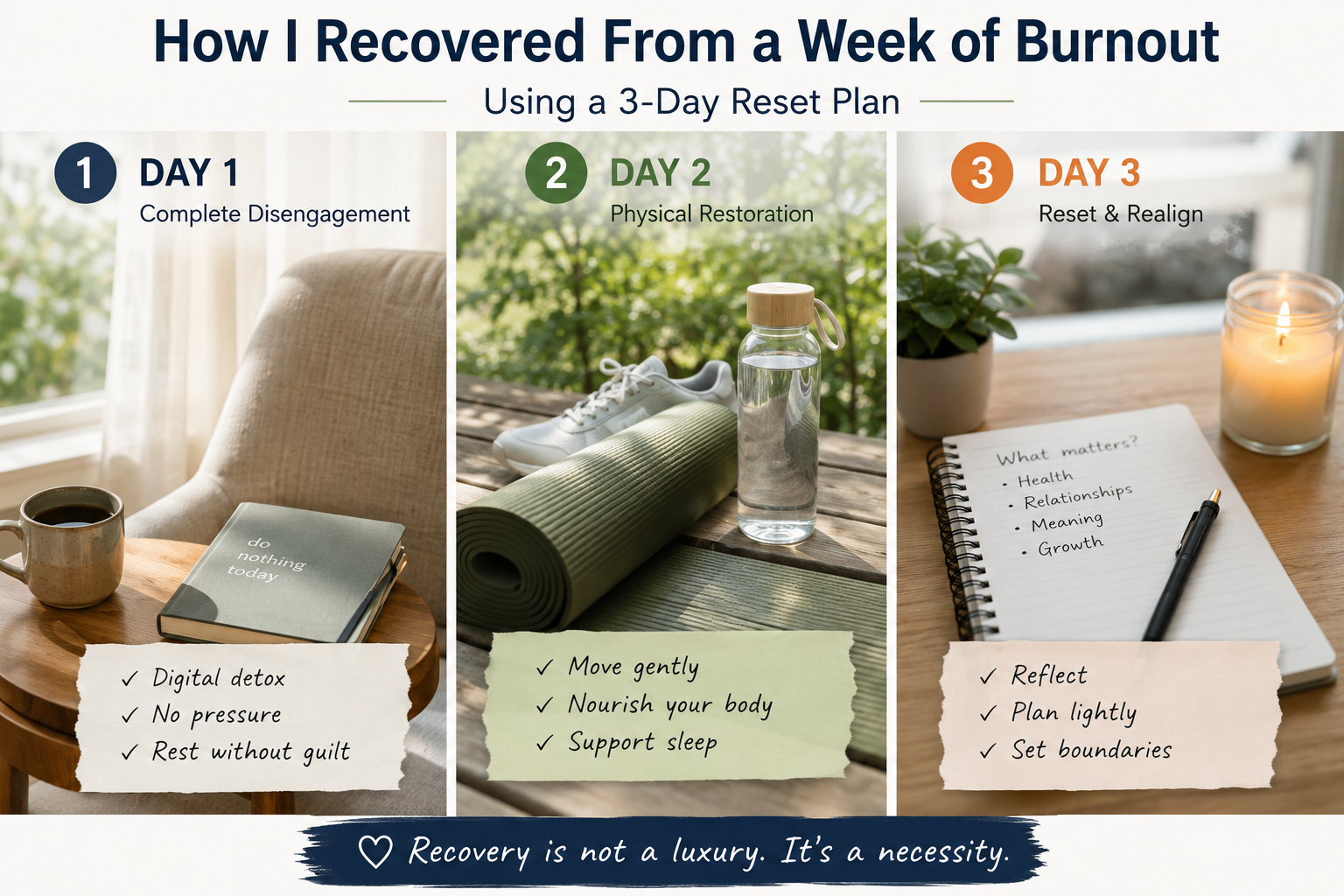
Day One: Complete Disengagement
The first day of my reset was not productive. It was not restorative in any active sense. It was simply a hard stop. I took a day off work—not a working-from-home day, not a light-meetings day, a genuine absence. I told my team I was unwell, which was true even if the illness was invisible.
I imposed a strict digital fast. No work email, no social media, no news, no podcasts, no audiobooks. The goal was to eliminate all inputs that required processing. My brain needed silence, not stimulation disguised as relaxation. I kept my phone for emergency calls only, with all notifications disabled.
I spent the day doing things that required no cognitive effort. I walked slowly in a nearby park without a destination. I sat on my balcony and watched clouds. I prepared simple food without following a recipe. These activities weren’t chosen for their benefits. They were chosen for their lack of demands.
The hardest part was the internal resistance. My mind kept suggesting productive alternatives. I should organize that closet. I should catch up on that show everyone recommends. I should at least read something. I ignored all of it. The discomfort of unstructured time was itself part of what needed healing. I had forgotten how to be still, and the first day was relearning.
The “Input Fasting” Rule That Made Day One Work
The most important boundary I set was not about what I did, but about what I consumed. No information inputs of any kind. This meant no reading, no screens, no music with lyrics, no conversations about work or current events. The only exception was nature—birdsong, wind, traffic noise. My brain had been processing information at maximum capacity for months. It needed a genuine fast, not a diet. The withdrawal was uncomfortable for the first few hours, like an addict missing a fix. By afternoon, a different quality of attention emerged. I noticed colors more vividly. I heard sounds I normally filter out. My thoughts, deprived of external fuel, began to slow and simplify. This wasn’t meditation. It was deprivation recovery. If you’re constantly consuming information without realizing its cumulative cost, my approach to managing mental overload might resonate—I wrote about it here.
Day Two: Physical Restoration
By the second day, the acute agitation had subsided. I felt quieter inside, though still tired. This was the signal to introduce gentle physical activity—not exercise for fitness, but movement for regulation.
I started the morning with twenty minutes of slow walking. Not power walking, not hiking, just walking at a pace that felt effortless. The goal was to stimulate circulation and lymphatic flow without elevating cortisol. I paid attention to my body as I moved, noticing tension I had been ignoring for weeks—tight shoulders, a clenched jaw, shallow breathing.
Midday, I did a gentle yoga sequence focused on hip openers and forward folds. These poses activate the parasympathetic nervous system and release stored tension in areas where stress accumulates. I held each pose for several minutes, breathing deeply, not striving for flexibility but simply allowing my body to settle.
The afternoon included a nap—not because I was sleepy, but because I was training my nervous system to rest during the day. I set a timer for thirty minutes and lay down without expectation. I didn’t sleep the full time, but the horizontal rest was restorative in itself. This was a deliberate reintroduction of daytime relaxation that I had abandoned in my pursuit of productivity.
Evening brought a long bath with Epsom salts. The magnesium absorption is modest, but the heat and buoyancy provided genuine physiological relief. More importantly, the bath created a container of time where I couldn’t do anything else. The enforced stillness was the medicine.
Day Three: Gentle Re-engagement
The third day was about testing my recovery without rushing back to full speed. I introduced light mental activity and observed my response. If I felt activated or depleted, I retreated. If I felt stable, I proceeded cautiously.
I spent the morning in nature, this time with a notebook. Not for work, not for planning, but for unstructured writing. I captured thoughts, observations, feelings—whatever emerged without agenda. This was my brain’s first opportunity to process in a controlled way after two days of fasting. The output was messy and unimportant, but the act of writing seemed to clear residual clutter.
Midday, I had a conversation with a friend about nothing in particular. Not about my burnout, not about work, just ordinary life. Social connection without purpose was something I had neglected, and its restorative power surprised me. The simple experience of being heard and hearing someone else, without any transactional agenda, filled a need I hadn’t named.
Evening brought the first reintroduction of structured activity. I prepared a meal from a recipe, something I enjoy but had abandoned in favor of convenience. The focused attention required—chopping, timing, seasoning—was light enough not to strain me but structured enough to test my returning capacity. It went well. I felt engaged without overwhelmed, present without depleted.
The Boundary I Set Before Returning to Work
The evening of day three, before I would re-enter work the following morning, I wrote down three non-negotiable changes. First, no work communication after 6:00 PM or before 8:00 AM. Second, one full day per week with no work of any kind. Third, a daily twenty-minute walk with no purpose, no podcast, no phone. These weren’t ambitious wellness goals. They were survival boundaries, the minimum required to prevent immediate relapse. I shared them with my manager and my closest collaborator. Making them explicit and public increased my commitment. The most important of these—protecting my evenings and weekends—became the foundation of my sustained recovery. I wrote about how a single work boundary transformed my Sunday anxiety in this article.
What I Didn’t Do (And Why)
The reset’s effectiveness came partly from what I excluded. I see now that common recovery advice would have undermined my healing.
I didn’t catch up on work. The temptation was strong—my inbox was full, deadlines loomed, and I felt guilty about my absence. But catching up would have negated the reset entirely. The point was to create distance from work patterns, not to condense them into a shorter timeframe.
I didn’t set recovery goals. No meditation targets, no step counts, no journaling prompts. Goals are productive structures, and productivity was what had broken me. I allowed myself to simply be, measuring success only by whether I felt slightly less terrible than the day before.
I didn’t explain myself extensively. I told my team I was unwell and left it at that. The urge to justify, to detail my burnout story, to seek validation for my need to rest—these were extensions of the performative productivity that had contributed to my depletion. I practiced receiving care without earning it.
I didn’t plan my return during the reset. The third day included no work preparation, no inbox review, no Monday planning. I would face work when I faced it. Anticipatory stress would have contaminated the final day of recovery.
The Surprising Realizations That Emerged
The silence of the reset created space for insights that my busy life had suppressed. Some were uncomfortable. All were valuable.
I realized that much of my work stress was self-generated. I had been responding to emails within minutes not because anyone required it, but because I had trained others to expect it. My availability was a habit I had created, not a demand imposed on me.
I noticed how much of my identity was tied to productivity. Without work to define me, I felt unmoored. This was painful to acknowledge but essential to address. I needed to cultivate sources of self-worth that didn’t depend on output.
I recognized that my rest had been performative too. Weekend activities, evening entertainment, even exercise had been chosen for their productivity value—fitness, networking, self-improvement. I had forgotten how to do things simply because they felt good in the moment.
Most importantly, I understood that burnout wasn’t a character flaw or a temporary setback. It was feedback. My system was telling me that my current operating parameters were unsustainable. Ignoring that feedback would lead to more severe consequences. Responding to it required not just recovery, but redesign.
The Long-Term Changes That Stuck
The three-day reset was an intervention, not a cure. Sustained recovery required ongoing changes that I implemented gradually. I started saying no to non-essential commitments without guilt. I scheduled recovery time with the same rigor I scheduled meetings. I reduced my information consumption by half, eliminating news and social media that provided no value but plenty of activation. I established a consistent sleep schedule that I protect as fiercely as any work deadline. Most valuably, I began checking in with myself weekly—how is my energy, my enthusiasm, my capacity for rest? This simple practice catches drift before it becomes burnout. If you’re looking to build sustainable routines that prevent depletion, my approach to balancing weekly habits without burnout might help—I detailed it here.
What I Would Do Differently Next Time
I hope there isn’t a next time, but if burnout threatens again, I would adjust my response based on what I learned.
I would start the reset sooner. I waited too long, pushing through warning signs that were already clear. Earlier intervention would have required less recovery time and caused less collateral damage to my relationships and work quality.
I would involve someone else. I did the reset alone, which was necessary for the disengagement but left me without support during the difficult emotional processing. A trusted friend checking in lightly would have helped without compromising the solitude I needed.
I would be more patient with the timeline. I expected to feel fully restored after three days. In reality, I felt significantly better but not complete. Full recovery took several weeks of sustained boundary-keeping. The reset launched the process; it didn’t finish it.
I would also document the experience more thoroughly. The insights that emerged were vivid during the reset but faded as I returned to normal life. Writing them down would have preserved the clarity that motivated my changes.
Where I Am Now
Eight months after the reset, I remain vigilant but no longer fearful. I understand my warning signs now—the irritability, the unrefreshing sleep, the loss of enjoyment in work I normally value. When they appear, I don’t push through. I adjust immediately, usually by reducing inputs and protecting sleep for a few days.
The boundary changes I implemented have held. My evenings are protected. My weekends contain genuine rest. My work is still demanding, but it no longer consumes my entire life. I have proven to myself that I can be effective without being available constantly.
Most valuably, I have rebuilt my relationship with rest. It is no longer something I earn through productivity or squeeze into remaining time. It is a non-negotiable foundation that makes everything else possible. The three-day reset taught me that recovery isn’t a luxury or a weakness. It is maintenance, as essential as food or sleep, and ignoring it carries consequences that eventually force attention.
If you recognize yourself in my description of creeping depletion, I urge you to act before collapse. Design your own reset. Make it specific, make it protected, make it non-negotiable. The time you invest in recovery will return to you multiplied, not just in productivity but in presence, joy, and the simple capacity to be alive without performing.
The 3-Day Reset Plan Summary
Day One — Complete Disengagement:
- No work, no screens, no structured input of any kind
- Spend time in nature, prepare simple food, sit in silence
- Expect discomfort; this is withdrawal from constant stimulation
Day Two — Physical Restoration:
- Gentle walking, restorative yoga, unstructured napping
- Warm bath, simple nourishing meals, early bedtime
- Focus on nervous system regulation, not fitness
Day Three — Gentle Re-engagement:
- Light nature walk with optional unstructured writing
- Purposeless social connection with a friend
- Structured but enjoyable activity to test returning capacity
- Evening: define and communicate three non-negotiable boundaries before returning to work
Related Articles
- The Single Boundary I Set at Work That Reduced My Sunday Anxiety
- Managing Work Pressure Without Losing Daily Mental Clarity
- How I Reduce Mental Overload During Extremely Busy Workdays
- Signs Your Daily Routine Is Hurting Your Energy Without You Realizing It
- A Balanced Weekly Home Workout Schedule That Prevents Burnout
- Simple Digital Detox Habits That Work
Sources and References
- Maslach, C., & Leiter, M. P. (2016). “Understanding the burnout experience: Recent research and its implications for psychiatry.” World Psychiatry, 15(2), 103-111.
- Sonnentag, S., & Fritz, C. (2007). “The Recovery Experience Questionnaire: Development and validation of a measure for assessing recuperation and unwinding from work.” Journal of Occupational Health Psychology, 12(3), 204-221.
- Parker, G., & Tavella, G. (2021). “Burnout: A review of current knowledge and future directions.” Australian & New Zealand Journal of Psychiatry, 55(6), 545-549.

Abdur Rahman is a lifestyle writer focused on simple health habits and everyday wellness. He creates easy-to-understand content that helps readers improve their routines without confusion or pressure. His work covers topics like daily health habits, home fitness, simple nutrition, sleep, and stress management. He believes that small, consistent actions lead to meaningful long-term results and aims to make healthy living practical, realistic, and accessible for everyone.