My mind has never been particularly effective at turning off. For years, the moment I lay down to sleep, a floodgate opened. Tomorrow’s deadlines, unresolved conversations, financial concerns, random memories from childhood—everything my brain had suppressed during the day rushed in at once. I would lie awake for an hour or more, mentally rehearsing scenarios that would never happen and solving problems that didn’t need solving at midnight.
I tried the standard advice. Meditation apps, breathing exercises, progressive muscle relaxation, counting backward from a hundred. Each technique worked once or twice, then lost its power as my mind learned to multitask through it. I could count backward while simultaneously planning my grocery list. The relaxation was superficial, and the thoughts always returned.
What finally broke the cycle wasn’t a relaxation technique at all. It was an organizational one. A simple two-minute practice of externalizing my thoughts onto paper before entering the bedroom. No structure, no analysis, no attempt to solve anything. Just a raw dump of whatever occupied my mind. The effect was immediate and has remained consistent for over a year.
Why My Brain Wouldn’t Let Me Sleep
The human mind has a peculiar relationship with unfinished business. Unresolved tasks, open loops, and ambiguous situations create a low-grade anxiety that the brain tries to resolve through rumination. During the day, activity and distraction suppress this process. At night, in the stillness of a dark room, it dominates.
Psychologists call this the Zeigarnik effect—the tendency to remember uncompleted tasks more readily than completed ones. My brain wasn’t tormenting me for no reason. It was trying to protect me by ensuring I didn’t forget important responsibilities. The problem was that midnight is the worst possible time for productive planning, and lying in bed thinking about problems doesn’t actually solve them.
I also had a habit of using bedtime as my first moment of genuine reflection. My days were packed from wake to evening, with no dedicated time for processing. The bedroom became my de facto thinking space by default. This created a powerful association: bed equals problem-solving, which is the opposite of what bed should signal.
Understanding this dynamic changed my approach. I didn’t need to suppress my thoughts or force relaxation. I needed to give my brain what it wanted—acknowledgment and capture—at a more appropriate time.
What the Worry Dump Actually Looks Like
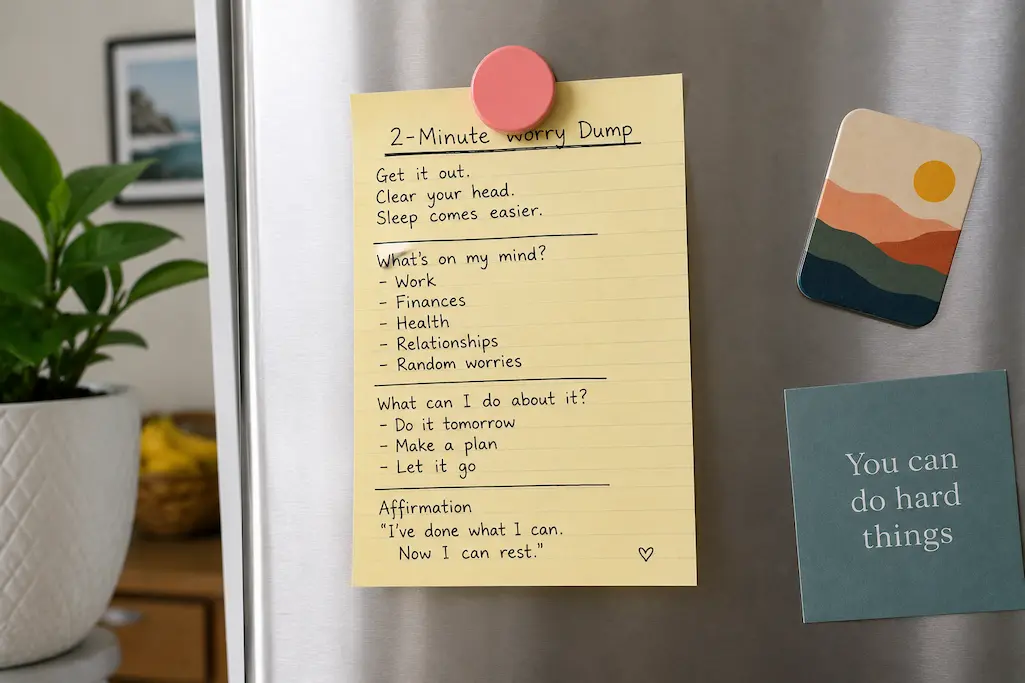
The practice is deliberately unstructured. I sit in a chair outside my bedroom—never in bed—with a simple notebook and pen. I set a timer for two minutes. Then I write continuously, without editing or organizing, every thought that comes to mind.
The entries are not journal entries. They are not coherent narratives or insightful reflections. They are fragmented, repetitive, often nonsensical. A typical page might include: “Email Sarah about the report. Worried I sounded rude in that meeting. Need to fix the kitchen faucet. Why did I say that thing three years ago? Call dentist. Feeling behind on everything. Remember to buy olive oil. That conversation with Mom felt off.” No punctuation, no complete sentences, no prioritization. Just extraction.
The physical act of writing matters. Typing on a phone or laptop doesn’t produce the same effect. There’s something about the slowness of handwriting, the tactile connection between thought and paper, that satisfies the brain’s need for processing. Digital capture feels too easy, too ephemeral. The paper holds the thoughts, literally removing them from my mental space.
When the timer ends, I close the notebook immediately. I do not review what I wrote. I do not create action items or to-do lists from it. The dump serves no organizational purpose beyond capture. Attempting to turn it into a productivity tool would reactivate the problem-solving mode I’m trying to exit.
The Exact Setup That Makes This Effortless
I keep a dedicated notebook and pen on a small table next to my reading chair. Not my work desk, not my kitchen counter, not my nightstand. A specific location that I associate with the pre-bed routine. The notebook is cheap and unlined—no pressure to write neatly or preserve it. The pen is reliable and comfortable. I never have to search for materials, which removes friction that might derail the habit. The entire setup cost less than five dollars and has outperformed every sleep aid I’ve tried. If you’re building habits that stick, the environment design matters as much as the behavior itself. I wrote about creating spaces that encourage consistency here in a different context, but the principle applies everywhere.
Why Two Minutes Is the Magic Number
I experimented with longer durations. Five minutes, ten minutes, even a full journaling session. Longer dumps didn’t produce better sleep. They produced more rumination. The extended time allowed my mind to wander into analysis, planning, and emotional processing—the exact activities that keep me awake.
Two minutes creates productive pressure. Knowing the timer will sound soon forces me to write quickly and superficially. I capture thoughts without dwelling on them. There’s no time to spiral into a particular concern or follow a thread to its anxious conclusion. The brevity is protective.
Two minutes is also non-threatening. On nights when I’m exhausted or resistant, I can tell myself it’s just two minutes. That’s shorter than brushing my teeth. The low commitment makes consistency possible, and consistency matters far more than intensity for habit formation.
Occasionally, the timer sounds and I still have thoughts flowing. I stop anyway. The practice isn’t about capturing everything. It’s about capturing enough to satisfy my brain’s need for acknowledgment. What remains unwritten rarely resurfaces once I’m in bed. The act of dumping seems to signal completion to my mind, even when the content is incomplete.
The Science Behind Why Externalization Works
The worry dump operates on a principle well-established in cognitive psychology: the brain treats externalized information differently than internalized information. When a thought remains in your head, your brain assumes it needs active monitoring. When that same thought is recorded externally, the monitoring responsibility transfers to the external storage.
This is why to-do lists reduce anxiety even when you never look at them again. The brain recognizes that the information is preserved and stops using working memory to maintain it. The worry dump extends this principle to emotional and ambiguous content, not just tasks. By writing down “worried about the meeting,” my brain accepts that the worry has been noted and doesn’t need to be rehearsed throughout the night.
Research on expressive writing supports this mechanism. Studies by James Pennebaker and others have shown that brief writing about stressful experiences reduces intrusive thoughts and improves sleep quality. The worry dump is a stripped-down, daily version of this intervention. Rather than processing deep trauma, it simply clears the mental cache of accumulated daily debris.
The timing also matters. Performing the dump shortly before bed ensures that the day’s accumulation is fresh and complete. Doing it too early allows new thoughts to accumulate before sleep. Doing it in bed contaminates the sleep environment with wakefulness. The specific placement—after evening wind-down activities but before entering the bedroom—creates a clean transition between mental activity and rest.
When the Dump Doesn’t Feel Like Enough
Some nights, two minutes of rapid writing feels insufficient. A major concern looms too large to dismiss with brief capture. On these occasions, I add a second step. After the timer sounds, I write one sentence describing the next concrete action I could take regarding that concern. Not a plan, not a solution, just a single step. “Email Sarah in the morning.” “Call the bank during lunch.” This minimal forward motion satisfies my brain’s need for progress without engaging full problem-solving mode. I then close the notebook and proceed to bed. The action sentence provides just enough resolution to prevent rumination without becoming a new source of mental activity. If your worries consistently exceed what two minutes can capture, it may indicate that your daytime stress management needs attention. I addressed my own mental overload during busy periods in this article.
How This Integrates With My Full Evening Routine
The worry dump doesn’t exist in isolation. It sits at a specific point in a sequence that prepares my body and mind for sleep. Understanding its placement helps explain why it works.
My evening begins ninety minutes before bed with light dimming and activity winding down. I prepare for tomorrow, clean the kitchen, and complete any remaining tasks that might nag at me. This reduces the volume of concerns that reach the worry dump stage.
Sixty minutes before bed, I sit in my reading chair with a physical book and herbal tea. This is my transition zone—neither active day nor passive night. The worry dump happens here, after I’ve settled in but before I’ve become drowsy. It’s the final mental clearing before I shift into sleep preparation.
Thirty minutes before bed, I enter my bedroom, which is reserved exclusively for sleep. No phone, no reading, no thinking. The worry dump has already happened. My mind is as empty as I can make it. I perform a brief breathing exercise—inhale for four, exhale for six—and allow sleep to arrive naturally.
This sequence creates a progression from activity to stillness, from mental engagement to rest. The worry dump is the bridge. Without it, thoughts from the day follow me into the bedroom. With it, they remain captured on paper in another room, physically and psychologically separate from my sleep space. The full evening routine that supports this is described here.
Unexpected Benefits Beyond Better Sleep
I started the worry dump for sleep improvement, but it has produced side effects I didn’t anticipate. The most surprising is increased morning clarity. By externalizing my thoughts the night before, I wake with a cleaner mental slate. I don’t spend the first hour of my day remembering what I was anxious about yesterday. I can engage with the morning directly rather than processing residual concerns.
I’ve also noticed improved emotional regulation. The act of writing down worries, even briefly, seems to reduce their emotional charge. Seeing “feeling behind on everything” on paper makes it feel less catastrophic than when it circulates endlessly in my head. The external perspective creates distance that dampens reactivity.
My daytime focus has improved too. Knowing that I have a designated time to process concerns prevents me from doing it during work hours. When an anxious thought arises at 2:00 PM, I can acknowledge it and defer it to the evening dump rather than engaging with it immediately. This reduces the cognitive fragmentation that previously disrupted my productivity.
Perhaps most valuably, the worry dump has made me more aware of my mental patterns. Reading back through old notebooks—something I do rarely, perhaps once a month—reveals recurring themes. The same worries appear again and again, often without resolution or evolution. This repetition makes them easier to recognize in real-time and question their validity. Many of my nighttime concerns are broken records, not genuine problems requiring attention.
The Habit That Made the Worry Dump Stick
I didn’t start doing this nightly immediately. I began with a commitment of just three nights per week, attached to an existing habit. After I finished my evening tea and opened my book, I did the dump before reading. This stacking made it automatic rather than requiring separate motivation. After three weeks of consistent practice, I expanded to nightly. Now I do it without decision or deliberation. The cue—sitting in my chair with tea—triggers the behavior without conscious intent. If you’re struggling to make this or any evening habit stick, I recommend starting small and anchoring to something you already do. Consistency compounds faster than intensity. My broader approach to building habits that survive busy periods is outlined in this article.
What I Don’t Do (And Why)
Over time, I’ve learned that certain modifications undermine the practice. I avoid them deliberately.
I don’t use a phone or computer for the dump. The digital environment is too stimulating and the input too fast. Handwriting creates a natural pace that matches the process.
I don’t review previous dumps. Looking back turns the practice into journaling, which has value but serves a different purpose. The worry dump is forward-looking only—clearing space for tonight. Retrospection reactivates old concerns and defeats the purpose.
I don’t share my dumps with anyone. The content is raw, often unfair, sometimes embarrassing. Knowing someone might read it would filter what I write, which would reduce the effectiveness. The notebook is private and disposable.
I don’t try to make the writing good. Grammar, spelling, legibility—none of it matters. I’ve written entire pages that I couldn’t decipher the next day. The value is in the act, not the artifact.
I don’t skip it when I feel fine. Some nights I sit down convinced I have nothing to write. Inevitably, something emerges once the pen starts moving. The absence of obvious anxiety doesn’t mean the mental cache is empty. It just means the contents haven’t surfaced yet.
Where I Am Now
After fourteen months of consistent practice, the worry dump has become as automatic as brushing my teeth. I rarely think about whether to do it. The ritual simply happens.
My sleep has transformed. I fall asleep within fifteen to twenty minutes on most nights, compared to the hour or more I previously struggled through. The quality of that sleep feels deeper too—I wake less frequently and feel more restored in the morning.
But the benefits extend beyond sleep metrics. I feel less burdened by my own mind. The constant background hum of unresolved thoughts has quieted significantly. I’m more present during the day because I’m not mentally rehearsing nighttime concerns. I’m more present at night because I’ve already given those concerns their due.
The two-minute investment is trivial compared to the returns. If you lie awake with a racing mind, I encourage you to try this simple practice. Not as a miracle cure, but as a systematic way to give your brain what it needs at a time when it can actually help you, rather than at midnight when it only hurts you.
Quick Start Guide to Your Own Worry Dump
- Materials: Cheap notebook and reliable pen, kept in a dedicated location
- Timing: 30-45 minutes before bed, after wind-down begins but before entering bedroom
- Duration: Exactly 2 minutes, timed
- Format: Continuous, unedited, unorganized writing of every thought that arises
- Afterward: Close notebook immediately, do not review, proceed to sleep preparation
- Frequency: Start with 3 nights per week, expand to nightly once habit is established
- Expectation: 2-3 weeks for noticeable sleep improvement, 6-8 weeks for full integration
Related Articles
- Evening Wind Down Routine That Improves Deep Sleep Naturally
- How I Trained Myself to Fall Asleep in Under 20 Minutes
- Fixing Mid-Night Wakeups With Simple Sleep Environment Changes
- What Changed When I Fixed My Sleep
- How I Reduce Mental Overload During Extremely Busy Workdays
- Simple Breathing Reset Technique During Overthinking Moments
Sources and References
- Zeigarnik, B. (1927). “Über das Behalten von erledigten und unerledigten Handlungen.” Psychologische Forschung, 9, 1-85.
- Pennebaker, J. W. (1997). “Writing about emotional experiences as a therapeutic process.” Psychological Science, 8(3), 162-166.
- Harvey, A. G., & Farrell, C. (2003). “The efficacy of a Pennebaker-like writing intervention for poor sleepers.” Behavioral Sleep Medicine, 1(2), 115-124.

Abdur Rahman is a lifestyle writer focused on simple health habits and everyday wellness. He creates easy-to-understand content that helps readers improve their routines without confusion or pressure. His work covers topics like daily health habits, home fitness, simple nutrition, sleep, and stress management. He believes that small, consistent actions lead to meaningful long-term results and aims to make healthy living practical, realistic, and accessible for everyone.