Balance and coordination are easy to overlook until everyday movement exposes a weakness. Standing on one leg while putting on shoes, stepping over an obstacle, changing direction quickly, or reaching for something from an awkward position all require more than muscle strength. Your brain, eyes, inner ear, joints, and muscles have to work together to keep your body controlled.
The good news is that you do not need complicated equipment to train these abilities. A small amount of floor space, a stable support surface, and consistent practice can provide enough challenge for an intermediate exerciser. The key is progression. Simply standing on one leg for the same amount of time every day eventually becomes familiar. Better results come from gradually changing the demands placed on your balance and coordination while keeping the movement controlled.
Balance and Coordination Are Related, But They Are Not the Same
Balance is your ability to maintain control of your body’s position. Coordination is your ability to organize movements smoothly and accurately. They overlap during many exercises. A single-leg squat, for example, requires you to maintain balance while coordinating your hip, knee, ankle, and trunk.
A useful way to think about the difference is the following:
- Balance: Can you maintain control?
- Coordination: Can you control the movement while doing something else?
- Dynamic balance: Can you remain stable while your body is moving?
- Proprioception: Can your nervous system sense where your body and joints are positioned?
This is why an exercise can become more difficult without adding weight. Closing your eyes, changing your foot position, reaching with your arms, or moving in a different direction can alter the challenge considerably.
Start With Controlled Single-Leg Work
Single-leg exercises are a practical starting point because they reduce your base of support without requiring complicated equipment.
Single-leg stand with reach
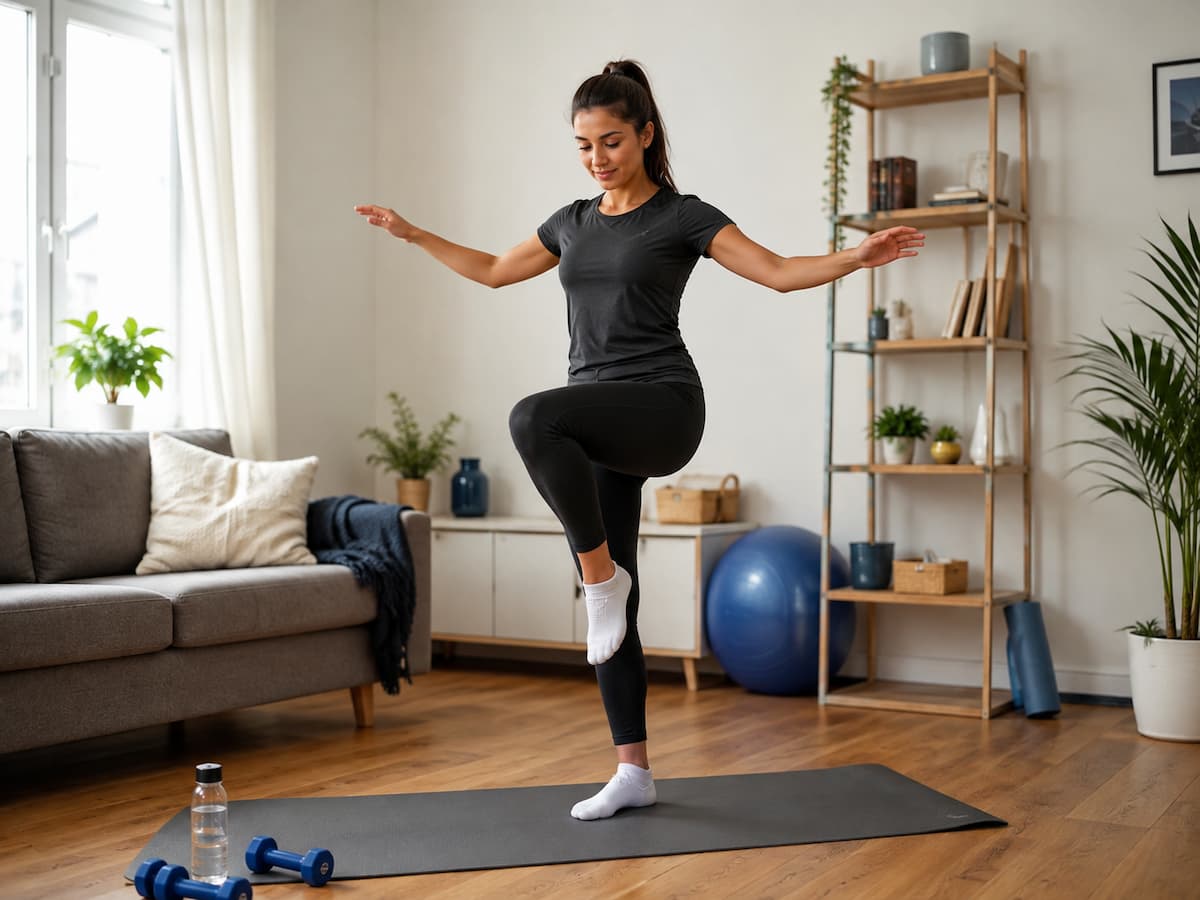
Stand near a sturdy counter, wall, or other reliable support. Shift your weight onto one foot and lift the opposite foot slightly from the floor. Once you are stable, slowly reach the lifted leg forward, to the side, or backward without allowing your standing knee or torso to collapse inward. Return to the starting position and repeat.
For an intermediate exerciser, try 2–3 sets of 5–8 controlled reaches per direction on each side. The goal is not to see how far you can reach. The useful part is maintaining control as your center of mass shifts. If necessary, keep one or two fingers against a stable surface. Assistance does not make the exercise pointless; it lets you practice the movement without repeatedly losing control.
Add Movement With a Step-and-Hold Drill
Static balance has limited carryover if you never practice controlling your body while moving. Place your feet about hip-width apart. Step forward with one foot and pause when it lands. Hold the position briefly before returning to the starting stance. Repeat on the other side.
Once that feels comfortable, vary the pattern:
- Forward step and hold
- Side step and hold
- Diagonal step and hold
- Backward step and hold
Keep the steps deliberate rather than turning the drill into a speed exercise. The backward version deserves particular attention because it changes the visual information available to you. Practice it only in a clear area with reliable support nearby.
Use a Clock-Reach Pattern for Greater Control
A simple clock pattern can combine balance, hip control, and directional movement. Imagine that the floor around your standing foot is a clock face. While balancing on one leg, lightly tap the floor at several positions around you with the other foot.
You might use positions corresponding roughly to the following:
- 12 o’clock
- 3 o’clock
- 6 o’clock
- 9 o’clock
Then add diagonal positions as your control improves. Keep the supporting foot planted and avoid twisting aggressively through the knee. This drill is particularly useful because the challenge comes from repeatedly moving your center of mass in different directions. You are training control rather than merely accumulating seconds of single-leg standing.
Improve Coordination With Opposite-Side Movements
Coordination often becomes more demanding when the arms and legs have to work together. Try a standing cross-body reach:
- Stand upright with your feet comfortably apart.
- Lift one knee.
- Reach across your body with the opposite hand.
- Return to the starting position.
- Alternate sides.
Move slowly at first. Once the pattern is automatic, increase the rhythm slightly without sacrificing posture. Another option is a march with opposite-arm movement. Raise one knee while swinging the opposite arm forward, then switch sides. These exercises are deliberately simple. Their value comes from requiring the nervous system to organize several body segments at the same time.
Try Heel-to-Toe Walking in a Safe Space
Heel-to-toe walking reduces your base of support and challenges control during movement. Walk slowly along a clear, level surface, placing the heel of one foot close to the toes of the opposite foot. Rather than looking constantly at your feet, keep your gaze generally forward when you feel comfortable doing so. Walk several steps, turn carefully, and return.
For a more challenging variation, change the direction of your gaze or introduce gentle head movements. However, do not add these changes if they make you unstable. A hallway can work well because it provides nearby walls for support, but avoid practicing beside furniture with sharp corners or objects that could cause you to trip.
Make Familiar Exercises More Difficult Without Adding Weight
Progression does not always require heavier dumbbells or more repetitions. You can increase a balance exercise’s difficulty by manipulating several variables:
| Progression | What changes |
|---|---|
| Wider stance → narrower stance | Less stability from the feet |
| Two legs → one leg | Smaller base of support |
| Static → moving | Requires control during motion |
| Arms still → arms reaching | Changes body position and center of mass |
| Slow movement → controlled faster movement | Increases coordination demands |
| Firm surface → appropriately challenging surface | Changes sensory feedback |
| Simple movement → combined movement | Requires greater coordination |
Do not increase several variables at once. If you turn a familiar exercise into a completely different challenge, it becomes harder to identify what caused the loss of control.
A better approach is to change one element, practice it until it becomes reliable, and then progress again.
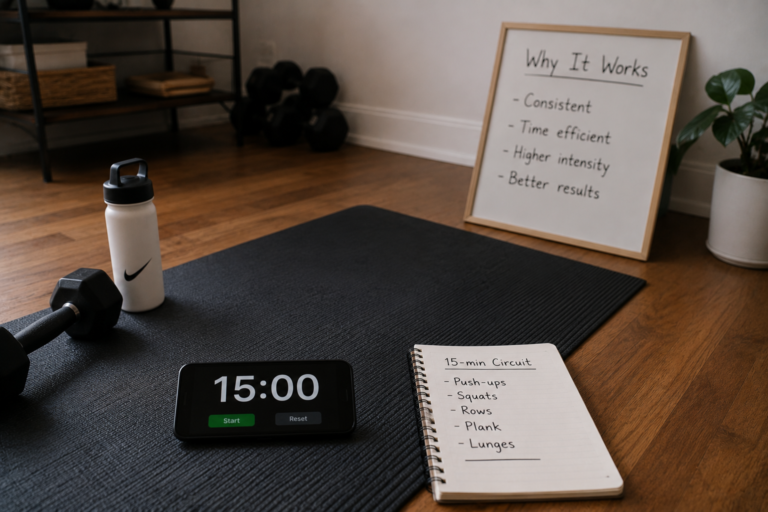
A 15-Minute Home Routine
If you want something practical rather than a long list of exercises, the following routine can fit into a small amount of space.
1. Controlled marching — 2 minutes
March slowly in place. Focus on upright posture and deliberate foot placement.
2. Single-leg stand with reaches — 3 minutes
Alternate legs and perform controlled forward, side, and backward reaches.
3. Step-and-hold sequence — 3 minutes
Practice forward, side, diagonal, and backward steps with a brief pause after each landing.
4. Cross-body knee-to-hand movement — 2 minutes
Alternate sides while keeping the movement smooth and controlled.
5. Heel-to-toe walking — 3 minutes
Walk along a clear path at a comfortable pace.
6. Repeat your most challenging drill—2 minutes
Finish with the exercise that requires the most concentration while still allowing you to maintain good form.
You do not need to perform the routine as quickly as possible. Quality matters more than speed. If fatigue causes your technique to deteriorate, reduce the duration or stop the exercise.
How Often Should You Practice?
Balance and coordination respond well to regular practice because the goal is partly skill development rather than simply muscular fatigue. A practical starting point is short sessions several times per week, with exercises performed while you are reasonably alert and not heavily fatigued.
You can also incorporate small amounts of balance practice into ordinary routines. For example, you could perform controlled weight shifts while waiting for something to finish, practice deliberate stepping patterns during a warm-up, or add single-leg work to an existing strength session. The important distinction is between practicing a skill and testing yourself.
Repeatedly pushing until you fall off balance is not necessarily better training. Most repetitions should remain controlled enough that you can recognize and correct small errors.
What About Closing Your Eyes?
Removing visual information can make balance substantially more challenging. However, it is not a progression that everyone should use casually. If you experiment with reduced visual input, use a stable environment, and keep dependable support within reach. Do not close your eyes during an exercise where losing balance could result in a fall.
For many people, there is plenty of room for progression before this becomes necessary. Single-leg reaches, directional stepping, controlled head movement, and more complex movement patterns can provide substantial challenges while keeping the environment predictable.
Common Problems That Limit Progress
1. Holding onto support too much
A support surface should help you maintain safety, not completely perform the balance task for you. Use the lightest assistance that allows you to complete the movement with control.
2. Moving too quickly
Fast repetitions can hide poor control. Slow the exercise down and see whether you can maintain the same position throughout the movement.
3. Training only one type of balance
Standing on one leg repeatedly is useful, but it does not cover every balance demand. Include static positions, stepping, reaching, and directional changes.
4. Always training when exhausted
Balance can become more difficult when you are tired. While some controlled challenge is useful, practicing technical movements when you can no longer maintain good control is counterproductive.
5. Progressing because an exercise feels boring
An exercise becoming familiar is not necessarily a problem. Instead of abandoning it immediately, ask whether you can improve the quality of movement or introduce one controlled progression.
When Home Balance Training Is Not the Right Place to Experiment
Balance problems can have many possible causes. A new or worsening loss of balance, repeated falls, unexplained dizziness, fainting, significant weakness, or difficulty walking normally warrants appropriate medical evaluation rather than simply adding harder balance exercises.
People recovering from an injury or dealing with a condition that affects movement should also follow advice from an appropriately qualified healthcare professional or physical therapist about which exercises are suitable. For ordinary fitness training, keep the environment simple: remove loose rugs and clutter, use stable footwear or an appropriate surface, and place yourself close to something sturdy when an exercise is unfamiliar.
How to Know When to Progress
A balance exercise is generally ready for a small progression when you can perform it consistently with controlled breathing, stable alignment, and minimal corrective movements. For example, if you can comfortably complete a single-leg stand with several controlled reaches, you might increase the reach distance slightly or add another direction. You do not need to immediately move to a dramatically harder exercise.
A useful progression cycle is the following:
Learn the pattern → stabilize the movement → add one challenge → repeat until controlled → progress again.
That approach makes balance training more measurable and reduces the temptation to chase difficulty for its own sake.
The Bigger Picture: Balance Is a Skill You Can Practice
Improving balance and coordination is less about finding one magical exercise and more about giving your nervous system varied opportunities to control movement. A useful home program should expose you to different demands: standing on one leg, shifting your weight, stepping in multiple directions, coordinating opposite limbs, and maintaining control while your body moves.
Keep the exercises challenging enough to require attention but manageable enough to perform safely. Over time, movements that initially require deliberate concentration can become much more automatic. The goal is not simply to stand still without wobbling. It is to become more capable of controlling your body while reaching, stepping, changing direction, and moving through everyday situations.
FAQs
1. How long does it take to improve balance and coordination?
The time required varies from person to person. Consistent practice helps you master specific movements, but overall improvement depends on various factors such as training experience, age, strength, mobility, and any underlying movement limitations.
2. What are the best balance exercises to do at home?
There is no single exercise that works for everyone. Standing on one leg, targeted stretches, step-and-hold exercises, and controlled walking movements all train different aspects of balance. Generally, combined exercises are more effective than performing isolated movements.
3. Can strength training improve balance?
Yes, strength and balance can complement each other. Stronger muscles provide better control during movement, while balance exercises specifically challenge your ability to coordinate and stabilize your movements.
4. Do I need to do balance training every day?
Short, simple exercises can be done regularly, but it doesn’t have to be an intense daily routine. If you feel tired or stiff after exercising, ensure you allow for sufficient recovery before repeating intense exercises.
5. Can I improve my coordination without equipment?
Absolutely. Marching drills, crossover steps, stepping exercises, stretching, and single-leg exercises can all be performed with virtually no equipment.

Abdur Rahman is a lifestyle writer focused on simple health habits and everyday wellness. He creates easy-to-understand content that helps readers improve their routines without confusion or pressure. His work covers topics like daily health habits, home fitness, simple nutrition, sleep, and stress management. He believes that small, consistent actions lead to meaningful long-term results and aims to make healthy living practical, realistic, and accessible for everyone.