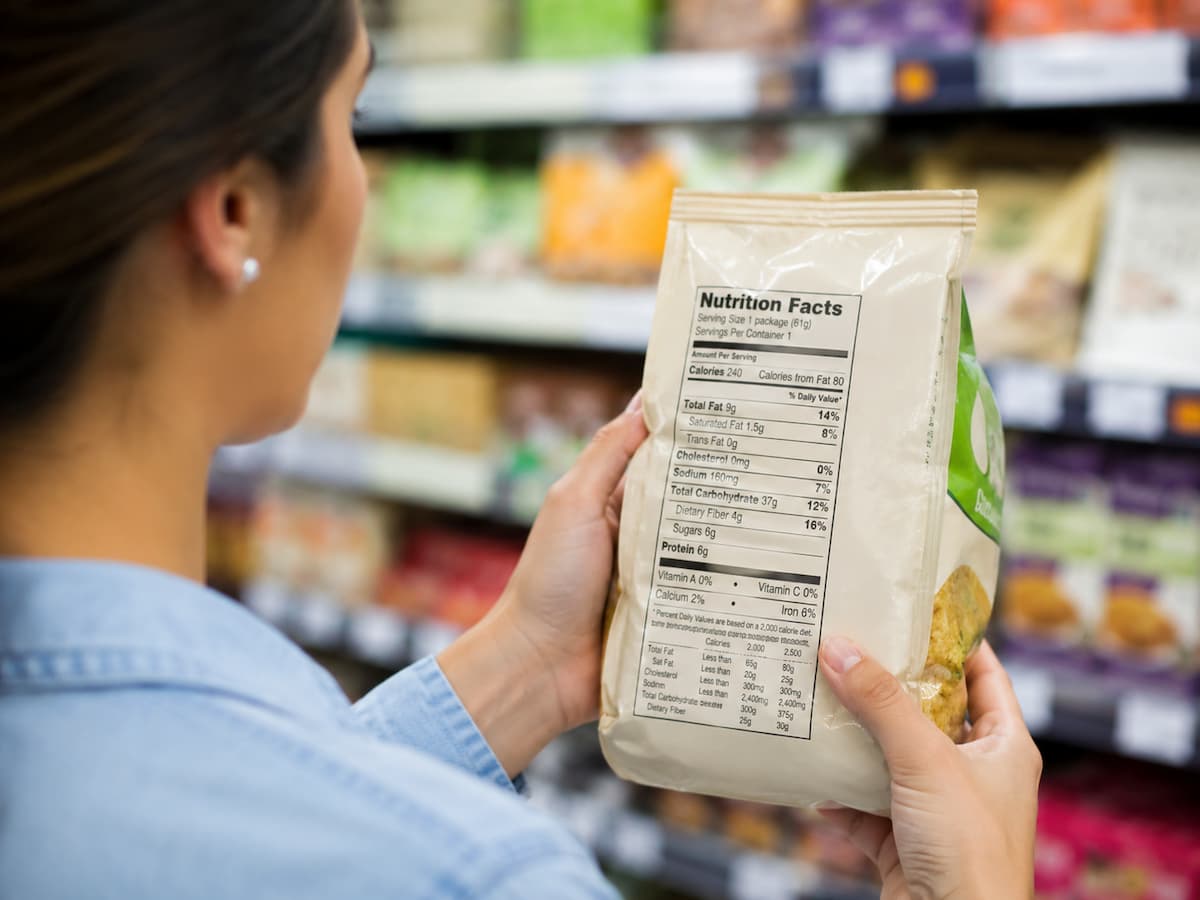
Nutrition labels can make an easy meal decision appear deceptively complex. A container may list calories, serving size, grams of fat, carbohydrates, protein, sugars, sodium, vitamins, percentages, and a comprehensive list of ingredients. You may feel like you have to make half a dozen sums before you decide what to buy if multiple products are put next to each other. You don’t.
The best approach to read a nutrition label is to read it in a consistent order. Start with the amount of food that the numbers actually describe, then look at calories, the nutrients that matter most for your particular pick, and finally the ingredients. Once you know what each of those numbers means, the label is much easier to decipher. Specific design and information requirements may differ by country. The following explanations are based on the fundamental principles shown on packaged-food nutrition labels and employ U.S.-style Nutrition Facts terminology when referring to words like “% Daily Value.”
Begin with the Portion Size
The first number to look for is the serving size. Almost everything else on the nutrition panel is based on the serving size. If a cereal box states one serving is 40 g and it has 150 calories in it. If you eat 80 grams, you have eaten two of the portions given. This means that the calories and other nutrients must be counted for two servings instead of one.
This is one of the easiest ways to go wrong with the label. A small box may look like it has one portion, but the nutrition information may be for only part of the item. Do not use the portion size mentioned as a recommendation for how much you should consume. It is the main reference amount for the presentation of the nutrition information. Your actual share could be bigger or smaller.
A useful first question is therefore:
“How much of this food am I actually going to eat?”
Then compare that amount with the serving size shown on the label.
Calories Tell You About Energy, Not Overall Quality
Calories indicate how much energy a food provides. They are useful, but a calorie number by itself does not tell you whether a food is nutritious or how filling it will be. For example, two snacks could contain a similar number of calories while having completely unique amounts of protein, fiber, saturated fat, sodium, or added sugars. Looking only at calories would miss those differences.
Calories become much more useful when considered alongside the portion you actually eat and the nutritional characteristics of the food. If a package contains multiple servings, calculate the total only when it helps answer a practical question. Eating two servings of a food that has 180 calories per serving means you take in 360 calories from it. You do not need complicated calculations beyond that.
Focus on the Nutrients That Matter for the Choice
You do not need to analyze every line with equal intensity. The nutrients you should pay particular attention to depend on the food and your dietary needs. For many packaged foods, useful information includes protein, fiber, saturated fat, sodium, total sugars, and added sugars where the label provides them.
Protein can be useful when comparing foods that you expect to contribute substantially to a meal or snack. Fiber can help distinguish between foods that contain similar amounts of carbohydrates but differ considerably in their fiber content. Saturated fat and sodium may also be relevant when comparing similar products, particularly if one option contains substantially more than another.
The point is that a nutrient should not always be at an extreme level. Context matters. A food can contain a nutrient that is useful in the diet while still being inappropriate for a particular dietary need or portion.
Understand the Difference Between Total Sugar and Added Sugar
Sugar is another area where labels can create confusion. Total sugars generally include sugars naturally present in foods as well as sugars added during processing. Added sugars refer specifically to sugars added during processing or preparation, where the labeling system identifies them separately.
For example, plain milk naturally contains lactose, while a flavored dairy product may contain both naturally occurring sugar and added sugar. This distinction helps you interpret the number rather than simply reacting to the word “sugar.” A food containing naturally occurring sugars is not nutritionally identical to a food containing the same amount of sugar from added sweeteners. When comparing similar packaged products, checking added sugar can therefore provide useful information that the total-sugar number alone does not show.
Do Not Treat Carbohydrates as a Single Type of Food
The carbohydrate line can look like one large number, but carbohydrates can come from different sources. Depending on the food, carbohydrates may include starches, sugars, and fiber. A carbohydrate-rich food can therefore have a completely unique nutritional profile from another food with the same total carbohydrate amount.
Consider two breakfast products with similar carbohydrate totals. One might provide considerably more fiber and less added sugar than the other. Looking only at the total carbohydrate number would hide that difference. This is why the surrounding lines on the label matter. Instead of asking whether a food is simply “high-carb” or “low-carb,” look at what contributes to the carbohydrate total and how the food fits into the meal.
Fiber Can Help You Compare Similar Foods
Fiber is listed separately from total carbohydrate on many nutrition labels, making it easier to identify foods that contain more dietary fiber. When comparing similar products, a higher fiber content can be one useful factor to consider. Whole grains, legumes, fruits, vegetables, nuts, and seeds are examples of foods that can contribute dietary fiber.
However, the label should not be treated as a scorecard in which every food with more fiber automatically wins. Taste, overall ingredients, portion size, affordability, and how the food fits into your diet can all matter.
For something like breakfast cereal, for instance, comparing fiber alongside added sugar and serving size may tell you considerably more than comparing calories alone.
Learn How % Daily Value Works
The percent Daily Value (%DV) is designed to put the amount of a nutrient into a broader daily context.
On U.S. labels, 5% DV or less is generally considered low, while 20% DV or more is generally considered high. These are useful reference points rather than strict judgments about whether a food is “healthy” or “bad.”
The important detail is that %DV is based on established daily reference values, not on your personal nutritional requirements. That means you should not interpret 20% DV as meaning that you personally need five servings of that food to reach 100%. Your individual needs can differ.
Instead, %DV is most useful for comparison. If two similar soups are sitting on the shelf and one has a much higher %DV for sodium, that immediately gives you useful information without requiring you to memorize the recommended daily amount.
Compare Similar Products Instead of Trying to Judge Foods in Isolation
Nutrition labels become especially useful when you compare products that serve the same purpose. Imagine you are choosing between three jars of pasta sauce. One has slightly fewer calories, another has less sodium, and the third has less added sugar. Which is best?
There is no universal answer. The decision depends on what matters most to you and how the sauce fits into the rest of the meal. The label allows you to make that decision using actual information rather than packaging claims. The same approach works for bread, breakfast cereal, yogurt, canned soup, frozen meals, snack bars, and many other packaged foods. Comparing the same serving amount and the same nutrients across products makes the numbers much more meaningful.
The Ingredient List Explains What Is Behind the Numbers
The nutrition panel tells you how much of various nutrients the food contains. The ingredient list provides you another perspective: what the food is made from. Ingredients are generally listed in descending order by weight, meaning ingredients present in greater amounts appear earlier in the list.
This can be particularly useful when comparing similar products. If two breads have similar calories but one contains more whole-grain ingredients while another relies heavily on refined flour, the ingredient lists can help you understand the difference. The ingredient list can also reveal sweeteners, oils, flavorings, allergens, and other components that may be important for your particular dietary needs.
You do not need to recognize every unfamiliar ingredient. A long chemical-sounding name does not automatically mean that an ingredient is harmful, just as a short ingredient list does not automatically make a product healthier. Consider the list as additional information rather than a reason to make quick judgments.
Ignore the Front of the Package Until After You Read the Label
Food packaging is designed to attract attention. Words such as “natural,” “light,” “high protein,” “multigrain,” or “made with whole grains” can sound impressive, but they do not replace the nutrition panel and ingredient list. A product can make a positive-sounding claim while still containing a substantial amount of a nutrient you are trying to limit.
This does not mean packaging claims are always misleading. It just means they don’t tell you everything. A better habit is to treat the front of the package as a description and the nutrition label as information you can use to verify whether the product actually fits your needs.
Watch for Foods With Multiple Servings
Serving size becomes particularly important with foods that are easy to consume in larger quantities. A bottle of a beverage, a bag of snacks, a container of nuts, or a large frozen meal may contain more than one listed serving. If you consume the entire package, the nutrition information for one serving does not describe your actual intake.
Some labels may provide additional information for the entire package, but you should still check how the serving information is presented. Before comparing two products, make sure you are comparing equivalent amounts. Otherwise, a product with a smaller listed serving could appear nutritionally different simply because the reference portions are different.
Do Not Let One Number Decide Everything
A common mistake is to search for the single “best” number on a label.
- Lowest calories? Not necessarily.
- Lowest carbohydrates? Not necessarily.
- Highest protein? Not automatically.
- Fewest ingredients? Not automatically.
Nutrition is more complicated than one number because foods serve different purposes. A handful of nuts and a bowl of soup do not need to have the same nutritional profile to both be useful foods.
Instead, identify the factors that are most relevant to the decision at hand. If you are choosing a snack, you might compare serving size, protein, fiber, and added sugar. If you are comparing canned soups, sodium may deserve more attention. If you are selecting bread, fiber and ingredients may be particularly useful. This turns label reading from a hunt for a perfect product into a practical comparison.
A Simple Four-Step Label-Reading Method
When you do not have time to analyze every detail, use a quick sequence.
- First, check the serving size. Make sure you understand how much food the numbers describe.
- Second, check calories based on the amount you actually expect to eat. Do not automatically assume the package equals one serving.
- Third, look at the nutrients relevant to your choice. Depending on the food, these may include protein, fiber, saturated fat, sodium, total sugars, or added sugars.
- Fourth, scan the ingredient list. Use it to understand the major ingredients and identify anything that matters to your dietary preferences or restrictions.
This process takes much less time than trying to interpret every number individually.
When Nutrition Labels Need Extra Care
Nutrition labels are useful, but they cannot answer every dietary question. People managing conditions that require specific dietary restrictions may need guidance tailored to their circumstances. Allergies, medically prescribed diets, and certain health conditions can require closer attention to ingredients, serving sizes, or particular nutrients.
If a healthcare professional or registered dietitian has given you specific dietary instructions, those instructions should take priority over generic label-reading advice. It is also worth remembering that packaged foods are only one part of a person’s diet. A label can help you make an informed choice about a particular product, but it does not tell you whether your entire diet is balanced.
Practice Reading Labels Without Overthinking Them
The more often you read nutrition labels, the less intimidating the numbers become. You do not need to calculate everything. Start with serving size, then look at the nutrients that are relevant to your decision, and use the ingredient list to add context. When two products are similar, compare them side by side rather than judging either one in isolation.
Over time, you will begin to recognize useful patterns. You will notice when a package contains several servings, when two apparently similar products differ substantially in sodium or added sugar, and when a marketing claim does not tell the complete story.
The purpose of a nutrition label is not to make eating more complicated. It is to give you information that packaging alone cannot provide. Once you know which numbers deserve your attention, reading the label becomes a quick practical skill rather than a confusing math exercise.
Conclusion
Reading nutrition labels is much easier if you don’t try to understand every single figure right away. Start with the serving size, adjust those figures to match the amount you actually eat, and finally, focus on the key nutrients in the specific foods you choose. Use the percentage of daily intake (%DV) as a tool for comparison and check the ingredient list for more information.
The most important thing is not to look for a “magic number” to decide whether a food fits your diet. The real value of nutrition labels lies in how they help you compare different options and make decisions based on a broader set of information.
FAQs
1. What should I look at first on a nutrition label?
Serving size: All the nutrient values on the label are based on this reference serving size, so you need to understand it to grasp the meaning of the other figures.
2. Are low-calorie foods necessarily healthier?
No. Calories are a unit of energy measurement, but they do not represent nutritional value. Compare protein, fiber, saturated fat, salt, carbohydrates, ingredients, and serving size to gain a deeper understanding of a food’s nutritional value.
3. What does 20% of your daily intake mean?
In the US nutrition labeling system, a serving of food containing 20% or more of the recommended daily amount of a nutrient is considered high, while less than 5% is considered low. The percentage of daily intake (%DV) is for information purposes only and does not constitute personalized nutritional advice.
4. Why is serving size important?
That is why nutrition labels show the content per serving. Generally speaking, eating two servings means consuming twice the amount of calories and nutrients listed on the label.
5. Are foods with a long list of ingredients harmful to my health?
“Not necessarily.” The number of ingredients does not necessarily indicate how healthy a food is. The ingredients themselves, the overall nutritional composition, and whether the food meets your nutritional needs are all crucial factors.
6. Are carbohydrates unhealthy?
Carbohydrates are just one of many nutrients in our diet. The nutritional value of these nutrients varies depending on the food source and the overall dietary context. Comparing factors such as dietary fiber, sugars, and ingredient lists can provide more useful information than looking solely at the total carbohydrate content.

Abdur Rahman is a lifestyle writer focused on simple health habits and everyday wellness. He creates easy-to-understand content that helps readers improve their routines without confusion or pressure. His work covers topics like daily health habits, home fitness, simple nutrition, sleep, and stress management. He believes that small, consistent actions lead to meaningful long-term results and aims to make healthy living practical, realistic, and accessible for everyone.