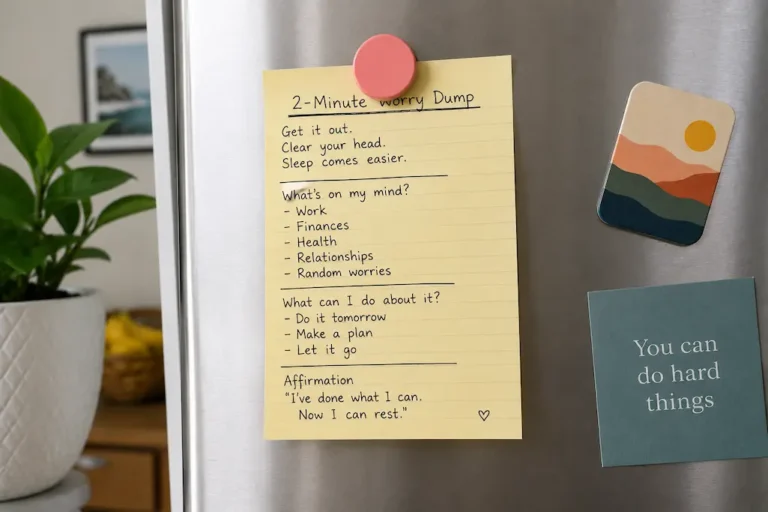

Sunday evenings used to trigger a specific kind of dread. Not the mild melancholy of a weekend ending, but a tightening in my chest, a racing mind, and a creeping sense that Monday was already consuming my remaining hours of rest. I would check my email “just once,” which led to reviewing a document, which led to mentally rehearsing the week ahead. By bedtime, I felt like I had already worked a full day without accomplishing anything tangible.
This pattern persisted for years. I told myself it was ambition, responsibility, the price of professional success. In reality, it was a boundary failure. I had allowed work to colonize my entire week, including the time explicitly designated for recovery. The Sunday anxiety wasn’t about Monday’s tasks—it was about my inability to protect my own rest.
The change came from a single, simple boundary that sounded almost too basic to matter. I stopped checking work communication after Friday evening until Monday morning. Not reducing frequency, not setting a time limit, not checking only urgent items. A complete, hard stop. The effect on my Sunday anxiety was immediate and has persisted for eighteen months. Here’s why this specific boundary worked when broader attempts at work-life balance had failed.
Why Sunday Anxiety Is a Boundary Problem, Not a Workload Problem
I spent years assuming my Sunday dread was caused by having too much to do. If I could just get ahead, delegate more, or become more efficient, the anxiety would resolve. I tried all three. None eliminated the Sunday feeling.
The real issue was anticipatory stress. Every time I checked work email on Sunday, I activated my brain’s threat-detection system. My mind began processing, planning, and problem-solving in preparation for Monday. This mental engagement continued subconsciously throughout the evening, preventing genuine rest and creating the exhaustion I was supposedly trying to avoid.
Even brief checks were damaging. A thirty-second glance at an inbox could trigger hours of background rumination. My brain doesn’t compartmentalize well—it doesn’t know that “just checking” isn’t “actually working.” The activation was binary. Once triggered, the stress response ran its course regardless of how brief the initial exposure.
I also noticed that Sunday check-ins never actually reduced Monday’s burden. They simply spread that burden across two days without improving outcomes. The tasks still waited. The meetings still happened. The only difference was that I had sacrificed my recovery time without gaining productivity in return.
The Specific Boundary and How I Enforced It
The boundary itself is embarrassingly simple: no work communication from Friday 6:00 PM to Monday 8:00 AM. This includes email, Slack, Teams, text messages from colleagues, and any work-related apps on my phone. Complete disengagement.
Enforcement required structural changes, not willpower. I removed all work apps from my phone entirely. Not logged out, not silenced—deleted. The friction of reinstalling and logging back in creates enough pause to prevent impulsive checking. My work communication happens on my laptop, which stays in a drawer from Friday evening to Monday morning.
I also communicated the boundary clearly. I told my manager, my direct reports, and my closest collaborators that I would not be available on weekends except for genuine emergencies, which I defined narrowly as situations requiring immediate action to prevent significant harm. I provided an alternative contact method for true emergencies—a phone call to my personal number, which no one has used in eighteen months.
The communication was uncomfortable initially. I feared appearing uncommitted or unprofessional. What I discovered was that most people respected the clarity. Colleagues who maintained similar boundaries appreciated the mutual protection. Those who didn’t simply adapted their timing. Very few work issues are genuinely time-sensitive across a weekend.
The “Emergency Definition” That Made This Possible
The boundary would have collapsed without a clear definition of what constitutes an emergency worth breaking it for. I established three criteria: immediate physical safety risk, active system outage affecting customers with no available workaround, or legal/regulatory deadline that cannot be moved. Everything else—including urgent but non-critical issues, client complaints, and internal deadlines—waits until Monday. Having this definition written down and shared removed the ambiguity that previously allowed “just this once” exceptions. In eighteen months, exactly zero situations have met these criteria. The emergencies I feared were largely imaginary. If you’re struggling with work bleeding into personal time, clarifying what actually constitutes an emergency might reveal how rarely your boundaries truly need to bend. I explored similar clarity around managing daily pressure in this article.
What Happened to My Sundays
The first weekend without work communication felt strange, almost illicit. I caught myself reaching for my phone multiple times, muscle memory seeking the dopamine hit of new information. By the second weekend, the urge had diminished. By the fourth, it was gone entirely.
Sunday evenings transformed most dramatically. Without the anticipatory activation, my mind remained in weekend mode until I chose to transition. I could read fiction without work thoughts intruding. I could have dinner with family without mentally drafting Monday emails. The boundary created a psychological container that protected my rest.
Monday mornings also improved. I arrived at work having actually recovered, rather than having pre-processed the entire week. My first hour was more focused and productive because my brain wasn’t already fatigued from Sunday evening engagement. The paradox was striking: by working less on Sunday, I performed better on Monday.
My creativity increased too. The idle time that Sunday previously filled with work rumination became space for unrelated thinking. I would notice connections, generate ideas, and solve problems that had stumped me during the week. The brain requires unfocused time for insight. By protecting that time, I accidentally improved my professional effectiveness.
Why Broader Work-Life Balance Attempts Failed
I had tried versions of this boundary before, but they were always compromised by flexibility. “I’ll check less often.” “I’ll only look at urgent items.” “I’ll set a time limit.” These soft boundaries failed because they required constant decision-making, which itself became exhausting.
Every time I considered whether to check email, I engaged in mental negotiation. Is this urgent enough? Have I waited long enough? What if something important happened? This negotiation consumed nearly as much energy as actually checking, and it kept work present in my mind even when I wasn’t actively engaging with it.
The hard boundary eliminated negotiation entirely. There was no decision to make because the option didn’t exist. My phone had no work apps. My laptop was in a drawer. The boundary was structural rather than behavioral, which made it sustainable without ongoing willpower.
I also noticed that previous attempts focused on reducing work hours rather than protecting recovery quality. I had tried leaving the office earlier, taking longer lunches, scheduling exercise during the day. These were valuable but didn’t address the specific leak that was draining my rest: the Sunday evening intrusion that contaminated my entire weekend recovery.
The Ripple Effect on Weekday Boundaries
The Sunday boundary created unexpected improvements during the week. Having experienced genuine weekend recovery, I became less tolerant of work encroaching on weekday evenings. I started leaving my laptop at the office more often. I stopped checking email after dinner. I began treating my weekday evenings with the same protectiveness I had developed for weekends. The Sunday boundary wasn’t an isolated change—it was a gateway to broader boundary setting. Once I experienced how much better I felt with protected time, I couldn’t unlearn that knowledge. It became easier to enforce other limits because I had proof that the world didn’t collapse when I wasn’t constantly available. If you’re looking to build consistency in other areas of life, the same principle applies—protecting recovery time makes everything else more sustainable. I wrote about maintaining habits during demanding periods here.
Handling the Guilt and FOMO
The hardest part of this boundary wasn’t logistical. It was emotional. I experienced genuine guilt about not checking in. What if someone needed me? What if I missed something important? What if my absence created burden for colleagues?
I addressed this by examining the evidence. In the months before the boundary, how many Sunday check-ins had actually prevented a problem? Almost none. Most Sunday emails were non-urgent updates, FYIs, or messages that could have waited. The few genuinely time-sensitive items were either resolved by others or remained manageable Monday morning.
The fear of missing out was more persistent. I had internalized the belief that constant availability was a professional virtue, that responsiveness equaled commitment. Letting go of this identity required accepting that my value wasn’t measured by my inbox response time. This was uncomfortable but ultimately liberating.
I also realized that my Sunday availability had created an expectation I never intended to set. Colleagues had learned that I would respond on weekends, which meant they sometimes sent things expecting that response. By removing my availability, I removed that expectation, which actually reduced weekend communication directed at me. My boundary protected others as much as it protected me.
What I Do Instead of Working on Sunday
The boundary created a vacuum that I had to fill intentionally. Simply not working wasn’t enough—I needed constructive alternatives that occupied my mind and prevented the idle anxiety that previously drove me to my inbox.
I established a Sunday evening ritual that signals the transition to the week ahead without engaging work directly. I review my personal calendar, plan meals for the week, lay out clothes, and prepare my bag if I’m commuting. These logistical tasks provide a sense of readiness without activating professional stress.
I also schedule something enjoyable for Sunday evening—a favorite show, a phone call with a friend, a walk at sunset. Having an anticipated activity prevents the evening from feeling like dead time waiting for Monday. It gives Sunday its own purpose rather than treating it as Monday’s prelude.
Most importantly, I allow myself genuine boredom. The discomfort of unstructured time was what previously drove me to work. Now I sit with it, recognizing that rest isn’t always entertaining and doesn’t need to be. The ability to be still without productivity is itself a skill that improves with practice.
When the Boundary Gets Tested
No boundary survives perfectly. Twice in eighteen months, I’ve broken my Sunday rule. Once for a genuine system outage that met my emergency criteria. Once for a personal mistake—I had agreed to a Sunday deadline months earlier and forgotten to renegotiate. Both instances taught me something valuable. The system outage resolved quickly and didn’t ruin my Sunday because I treated it as an exception, not a precedent. The personal mistake reminded me to review commitments more carefully when scheduling. Neither instance weakened the boundary because I returned to it immediately afterward. The key isn’t perfect adherence. It’s treating violations as rare exceptions that require justification, not as evidence that the boundary is impractical. If you’re recovering from a period of poor boundaries, a structured reset can help reestablish your baseline. I described my own recovery approach in this article.
The Broader Lesson About Recovery
This boundary taught me something that extends beyond work. Recovery is not the absence of activity. It is the presence of protected space. My Sundays weren’t restful when I wasn’t working because I was still mentally engaged with work. True recovery requires psychological disengagement, not just physical distance.
I apply this principle to other areas now. Exercise recovery requires time away from training. Social recovery requires time alone. Creative recovery requires consumption without production. Each domain has its own version of the Sunday boundary—a hard stop that allows the system to reset.
The boundary also revealed how much of my stress was self-inflicted. I had blamed my job, my manager, my industry for my lack of rest. In reality, I was the one opening the door every Sunday evening. No one required it. No one even asked for it consistently. I had created my own prison and called it professionalism.
Breaking that pattern required acknowledging my complicity, which was uncomfortable but empowering. If I created the problem, I could also create the solution. The boundary was my solution, simple and specific and entirely within my control.
Where I Am Now
Eighteen months later, the boundary feels natural rather than forced. I don’t think about it much. Sunday evenings are simply mine again, protected by a structure that operates without my active intervention.
The anxiety hasn’t disappeared entirely. Some Sunday evenings still carry a hint of dread, usually when a genuinely challenging week awaits. But the intensity has diminished dramatically, and the duration has shortened. The feeling passes rather than consuming the entire evening.
More importantly, I’ve reclaimed a part of my life that work had colonized. My weekends feel complete rather than truncated. Monday arrives as a beginning rather than an extension of Sunday’s stress. The boundary created space that I didn’t know I was missing until I experienced it.
If you recognize yourself in my description of Sunday anxiety, I encourage you to consider what specific boundary might create the container you need. It doesn’t need to be as absolute as mine. But it does need to be clear, structural, and genuinely protected. Soft boundaries create soft results. The hard ones, paradoxically, are what make life feel softer.
Implementing Your Own Sunday Boundary
- Define the scope: What specific work communication will you eliminate? Be precise—”less email” fails, “no work apps on phone” succeeds
- Create structural barriers: Remove apps, use separate devices, or employ physical separation like drawer storage
- Communicate clearly: Tell relevant people your boundary and provide a narrow emergency exception path
- Define emergencies narrowly: Write down what justifies breaking the boundary to prevent “just this once” erosion
- Fill the vacuum: Plan Sunday evening activities that are genuinely engaging and unrelated to work
- Accept discomfort: The first 2-3 weekends will feel strange; this is adaptation, not evidence of failure
- Review after one month: Assess whether the boundary improved your Sunday experience and adjust scope if needed
Related Articles
- Managing Work Pressure Without Losing Daily Mental Clarity
- How I Recovered From a Week of Burnout Using a 3-Day Reset Plan
- How I Reduce Mental Overload During Extremely Busy Workdays
- How I Stay Consistent on Busy Days
- Simple Digital Detox Habits That Work
- Signs Your Daily Routine Is Hurting Your Energy Without You Realizing It
Sources and References
- Sonnentag, S., & Fritz, C. (2007). “The Recovery Experience Questionnaire: Development and validation of a measure for assessing recuperation and unwinding from work.” Journal of Occupational Health Psychology, 12(3), 204-221.
- Bennett, A. A., et al. (2018). “Work–family conflict: Linking work pressure to workplace emotional exhaustion.” Journal of Organizational Behavior, 39(4), 478-494.
- Sonnentag, S. (2003). “Recovery, work engagement, and proactive behavior: A new look at the interface between nonwork and work.” Journal of Applied Psychology, 88(3), 518-528.

Abdur Rahman is a lifestyle writer focused on simple health habits and everyday wellness. He creates easy-to-understand content that helps readers improve their routines without confusion or pressure. His work covers topics like daily health habits, home fitness, simple nutrition, sleep, and stress management. He believes that small, consistent actions lead to meaningful long-term results and aims to make healthy living practical, realistic, and accessible for everyone.