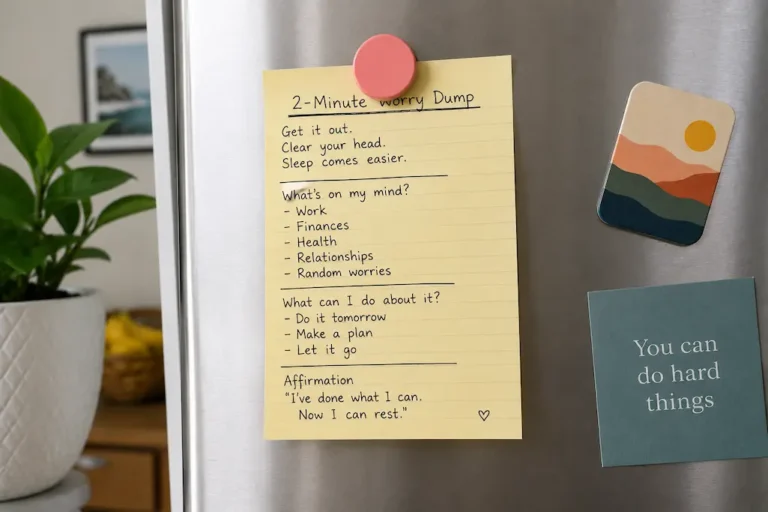

My mind used to race at the worst possible moments. Lying in bed at midnight replaying conversations from three years ago. Sitting in a meeting unable to hear what anyone was saying because my own internal monologue was shouting. Standing in the grocery store frozen by a decision as simple as which pasta sauce to buy.
I tried meditation apps. I tried journaling. I tried going for walks when the overthinking started. All of these helped, but none of them worked in the moment. When my mind was already spiraling, I did not have twenty minutes to sit on a cushion. I needed something that worked in sixty seconds, anywhere, without anyone noticing.
I found it by accident during a panic attack in a parking lot. A breathing pattern I had read about months earlier surfaced from memory, and I tried it because I had no other options. Within two minutes, my heart rate dropped. My thoughts slowed. The spiral stopped. That was two years ago. I have used this technique almost daily since.
What Overthinking Actually Does to Your Body
Overthinking is not just a mental problem. It is a physical state. When your mind races, your sympathetic nervous system activates. Your heart rate increases. Your breathing becomes shallow and rapid. Your muscles tense. Your digestion slows. Your body prepares for a threat that does not exist.
The problem is that this physical state makes rational thinking impossible. When your body is in fight-or-flight mode, blood flow shifts away from your prefrontal cortex — the part of your brain responsible for decision-making and perspective — toward your survival centers. You literally cannot think clearly because your biology is designed for running, not reasoning.
Research from the HeartMath Institute demonstrates that heart rate variability is directly linked to emotional regulation. When your breathing is erratic, your heart rhythm becomes irregular, which signals your brain that danger is present. This creates a feedback loop: anxious thoughts cause irregular breathing, which causes your heart to signal danger, which causes more anxious thoughts.
The Physiology of a Spiral
You cannot reason your way out of overthinking because overthinking is not a reasoning problem. It is a physiological state. Your brain is not broken. It is responding exactly as designed to a perceived threat. The solution is not to think differently. It is to change your body first so your brain can follow.
The Exact Technique: Box Breathing with a Modified Exhale
The technique is a variation of box breathing used by Navy SEALs to maintain calm under extreme stress. I modified the exhale phase after noticing that a longer out-breath was what actually stopped my spirals. Here is exactly what I do:
| Phase | Duration | What to Do |
|---|---|---|
| Inhale | 4 seconds | Breathe in through your nose, filling your belly first, then your chest. Count silently: one, two, three, four. |
| Hold | 4 seconds | Keep the breath in without straining. Your lungs feel full but not uncomfortable. |
| Exhale | 6 seconds | Breathe out through pursed lips or your nose, slower than the inhale. Count: one, two, three, four, five, six. This is the critical phase. |
| Hold | 2 seconds | Pause with empty lungs before the next inhale. This brief rest prevents hyperventilation. |
One full cycle takes sixteen seconds. I do five cycles, which is eighty seconds total. That is the entire intervention. In under two minutes, my physiology shifts from sympathetic activation to parasympathetic recovery.
The key is the six-second exhale. A longer exhale activates the vagus nerve, which signals your body that the threat has passed. This is not relaxation theory. It is hardwired biology. When you exhale slowly, your heart rate drops. When your heart rate drops, your brain receives the message that you are safe. The spiral loses its fuel.
Why the Exhale Matters Most
Most people focus on deep breathing without understanding that the exhale is what actually calms you. Inhaling is energizing. Exhaling is relaxing. If you are taking deep breaths but exhaling quickly, you are feeding the anxiety, not stopping it. The six-second exhale is non-negotiable.
How I Use This in Real Life
I have used this technique in situations where leaving or taking a break was impossible. Here is how I adapt it:
In meetings: I place one hand on my thigh under the table and breathe silently. No one can see my abdomen expanding. The hand on my thigh grounds me and provides tactile feedback that I am actually breathing, not just thinking about breathing.
While driving: I keep both hands on the wheel and breathe through my nose. The hold phases are shorter if traffic requires attention. Even three cycles at a red light makes a measurable difference before I arrive.
In bed at night: This is where I use it most. When my mind starts reviewing every awkward conversation I have ever had, I do ten cycles instead of five. The extended exhale becomes hypnotic. I rarely finish all ten before falling asleep.
During arguments: I excuse myself to the bathroom and do five cycles before responding. The pause prevents me from saying things I will regret. The breathing prevents me from carrying the argument in my head for hours afterward.
What Changed After 30 Days of Practice
I committed to using this technique every time I noticed overthinking starting, regardless of where I was or what I was doing. I tracked two metrics: how quickly the spiral stopped and how often I needed to use the technique at all.
| Metric | Week 1 | Week 4 |
|---|---|---|
| Average time to calm down | 8-12 minutes | Under 2 minutes |
| Daily overthinking episodes | 4-6 per day | 1-2 per day |
| Sleep onset time | 45-60 minutes | 15-25 minutes |
| Post-argument rumination | 2-3 hours | 10-20 minutes |
The most surprising change was that overthinking episodes became less frequent, not just shorter. I believe this happened because my body learned the breathing pattern as a signal. The moment I started the first cycle, my nervous system recognized what was coming. The anticipation of calm became almost as effective as the calm itself.
Why This Works When Other Techniques Fail
I have tried dozens of anxiety and overthinking strategies. Most of them failed for the same reason: they required me to think clearly while my thinking was already compromised. Telling someone to “just reframe your thoughts” during a spiral is like telling someone drowning to swim harder. The capacity is not there.
This technique works because it bypasses thinking entirely. You do not need to believe it will work. You do not need to understand the physiology. You only need to count to four, hold, count to six, hold, and repeat. The body does the rest. Your nervous system responds to the breathing pattern whether your mind cooperates or not.
Meditation requires you to sit still, find a quiet space, and focus. Journaling requires you to articulate your thoughts while they are chaotic. Walking requires you to leave the situation. This technique requires nothing except your breath and sixteen seconds. That accessibility is what makes it reliable.
The Accessibility Test
The best mental health technique is the one you will actually use. If a strategy requires a quiet room, twenty minutes, and a clear head, it will not help you in a crisis. This technique passes the accessibility test because it works in a bathroom stall, a traffic jam, or a crowded office. No equipment. No privacy. No preparation.
Common Mistakes That Reduce Effectiveness
When I taught this technique to friends, I noticed three consistent errors that made it less effective:
Rushing the exhale. People naturally want to get the breath out quickly so they can inhale again. This defeats the purpose. The six-second exhale must be genuinely slow. If you cannot make it to six seconds, start with four and work up. Speed is the enemy.
Counting too fast. Under stress, your internal count accelerates. Four seconds becomes two seconds without you noticing. I use a slow, deliberate pace: one-Mississippi, two-Mississippi. It feels absurd but it keeps the timing honest.
Stopping after one cycle. One cycle is not enough. Your nervous system needs repeated signals to shift states. I never do fewer than three cycles. Five is my standard. Ten is for severe moments. Think of it like knocking on a door — one knock might not be heard, but five gets attention.
How to Build This Into Your Daily Life
The technique is most powerful when it becomes automatic. Here is how I built the habit:
I attached it to a physical trigger. Every time I feel my jaw clench or my shoulders rise toward my ears, I start breathing. These physical signals appear before the mental spiral fully forms. Catching the early signs prevents the spiral from gaining momentum.
I practiced it when calm. This sounds backward, but rehearsing the technique during low-stress moments made it automatic during high-stress moments. I did five cycles every morning after brushing my teeth for two weeks. By the time I needed it in a crisis, my body already knew the pattern.
I told one person. I explained the technique to my partner so they could remind me when they saw me spiraling. External accountability matters when your internal state is compromised. Sometimes another person notices your tension before you do.
What This Technique Cannot Do
This is not a cure for clinical anxiety or trauma. It is a tool for managing acute overthinking moments. If your overthinking is constant, severe, or accompanied by other symptoms, professional support is necessary. No breathing technique replaces therapy or medical treatment.
It also cannot solve the problems you are overthinking about. It only clears the mental fog so you can address them rationally. After the breathing, you still need to make the phone call, have the conversation, or make the decision. The technique gives you the capacity to do so. It does not do the work for you.
But within its limits, this technique has been transformative for me. I no longer lose hours to mental spirals. I no longer lie awake replaying imaginary arguments. I no longer sit in meetings paralyzed by my own thoughts. I have a tool that works in under two minutes, anywhere, every time.
Start with five cycles today. Use them the next time your mind starts racing. Count slowly. Exhale fully. Let your body lead your mind back to stillness.
Related Articles
- Evening Wind-Down Routine That Improves Deep Sleep Naturally
- How I Reduce Mental Overload During Extremely Busy Workdays
- Managing Work Pressure Without Losing Daily Mental Clarity
- Simple Digital Detox Habits That Work
- Fixing Mid-Night Wakeups With Simple Sleep Environment Changes
- How I Stay Consistent on Busy Days
Sources and References
- Ma, X., et al. (2017). “The effect of diaphragmatic breathing on attention, negative affect and stress in healthy adults.” Frontiers in Psychology, 8, 874. https://www.frontiersin.org/articles/10.3389/fpsyg.2017.00874/full
- Zaccaro, A., et al. (2018). “How breath-control can change your life: A systematic review on psycho-physiological correlates of slow breathing.” Frontiers in Human Neuroscience, 12, 353.
- McCraty, R., & Childre, D. (2010). “Coherence: bridging personal, social, and global health.” Alternative Therapies in Health and Medicine, 16(4), 10-24.

Abdur Rahman is a lifestyle writer focused on simple health habits and everyday wellness. He creates easy-to-understand content that helps readers improve their routines without confusion or pressure. His work covers topics like daily health habits, home fitness, simple nutrition, sleep, and stress management. He believes that small, consistent actions lead to meaningful long-term results and aims to make healthy living practical, realistic, and accessible for everyone.